

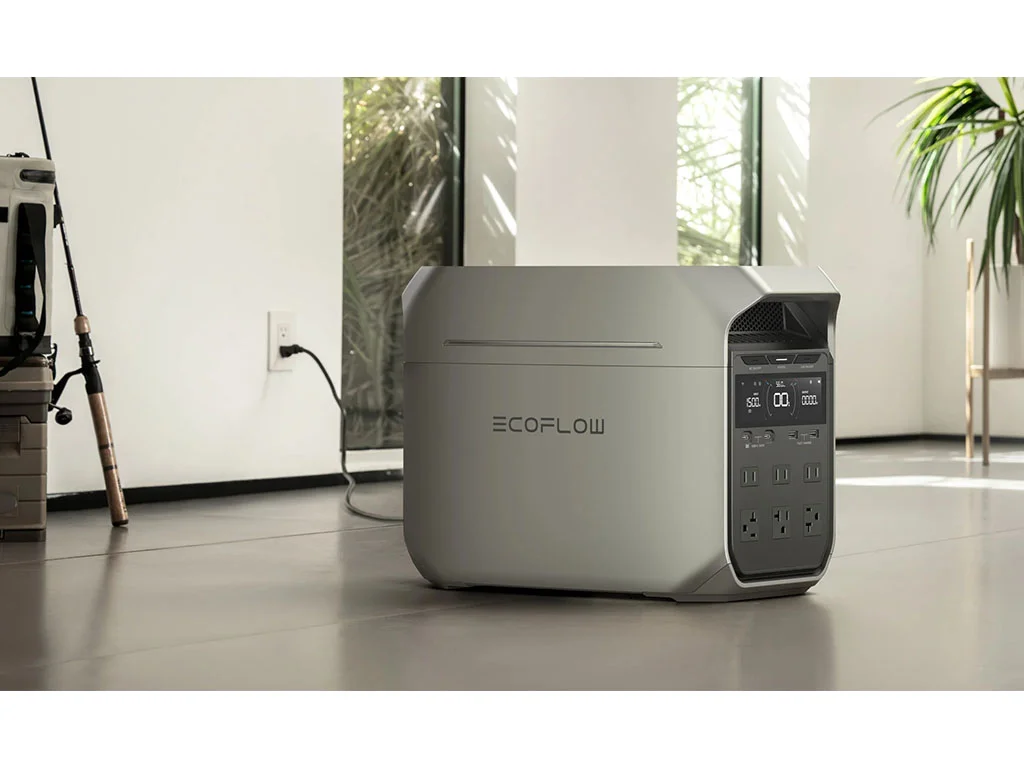
The EcoFlow DELTA 3 Plus and Bluetti AC180 are two noteworthy power stations. However, cutting through the marketing claims to uncover the differences can be challenging. Not anymore.
In this comparison, we provide an expert review of how the battle between the EcoFlow DELTA 3 Plus vs. Bluetti AC180 pans out. We’ll show you the best things about both models, while also providing full comparisons of the specs.
And we’ll see how they look compared to many other options with our exclusive tool where you can pick any power station in our database.
We carefully select the products and services we link to. If you buy through our links, we may earn a commission. There’s no extra cost to you and it helps us provide this information.
Quick Summary
Both of these portable power stations have a ton of great features. And they come from highly reputable companies you can trust, backed by a 5-year warranty. This choice between the Bluetti AC180 vs. EcoFlow DELTA 3 Plus is a tough call.
Under the microscope, we do have a clear winner. The EcoFlow DELTA 3 Plus comes out ahead because it has:
- Up to 5kWh battery capacity through modular expansion
- Double the solar charging speed
- Faster UPS transfer time and lighter weight
All three of these things make us favor the EcoFlow option. Prices of these change very often, but this EcoFlow has a lower MSRP than the Bluetti as well. It’s typically a better value. See our EcoFlow Sales and Prices for current deals.
But Bluetti has some advantages up its sleeve too. The ways that the Bluetti AC180 is better than the EcoFlow DELTA 3 Plus include:
- Larger internal battery capacity
- More USB-A ports
- Wireless charging pad
On top of that, Bluetti has two very similar models, including the AC180P with an even bigger internal battery (1.4kWh) and the AC180T with a 1.4kWh swappable battery system that pairs with the Bluetti portable fridge.
Which one is right for you? The EcoFlow DELTA 3 Plus is best if you want to get an external battery or use more than 500W of solar panels. It’s also the right choice if you want a UPS that has a better chance of keeping your computer running during a power outage (without rebooting).
If internal battery size or a wireless charging pad are your priorities, the Bluetti AC180 will do a better job.
| Product | EcoFlow DELTA 3 Plus | BLUETTI AC180 |
|---|---|---|
| Battery | 1,024Wh | 1152Wh |
| Battery (System Max) | 5,120Wh | 1152Wh |
| AC Output | 1,800W | 1,800W |
| AC Input | 1,500W | 1,440W |
| Solar Input | 1,000W | 500W |
| Warranty | 5 years | 5 years |
| 120V Outlets | 6 | 4x15A |
| UPS / EPS | 10ms | 20ms |
| Buy Now | Buy D3P | Buy AC180 |
| Buy on Amazon | Buy on Amazon | AC180 on Amazon |
|
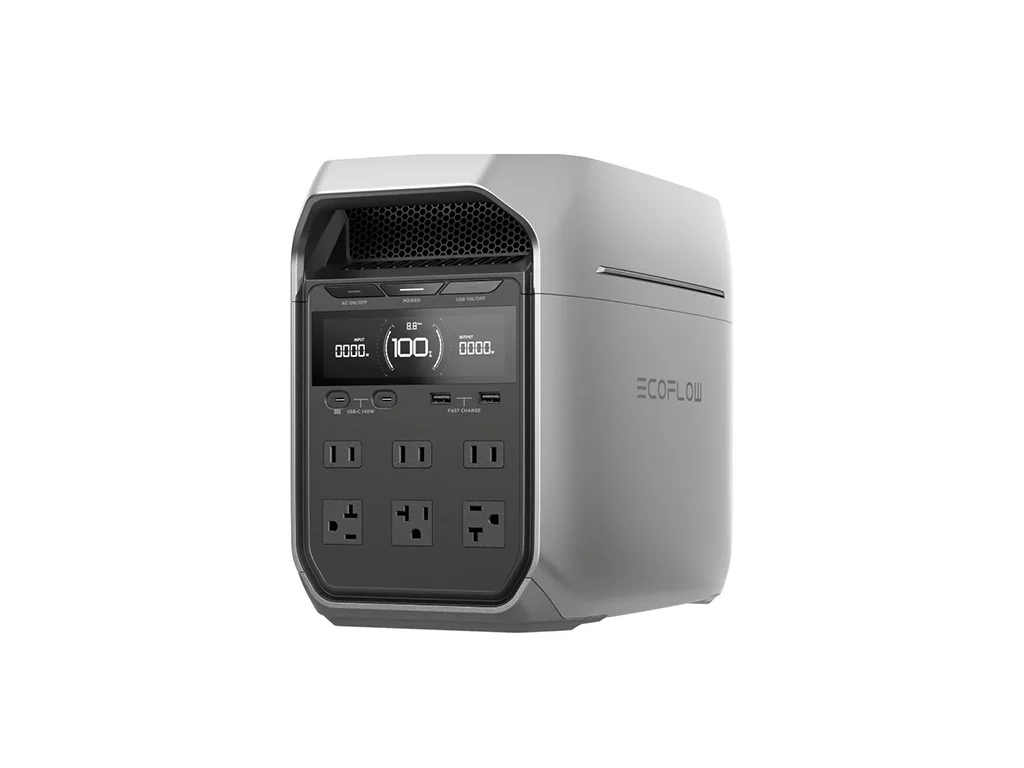
EcoFlow DELTA 3 Plus |
D3P on EcoFlow D3P on Amazon |
|
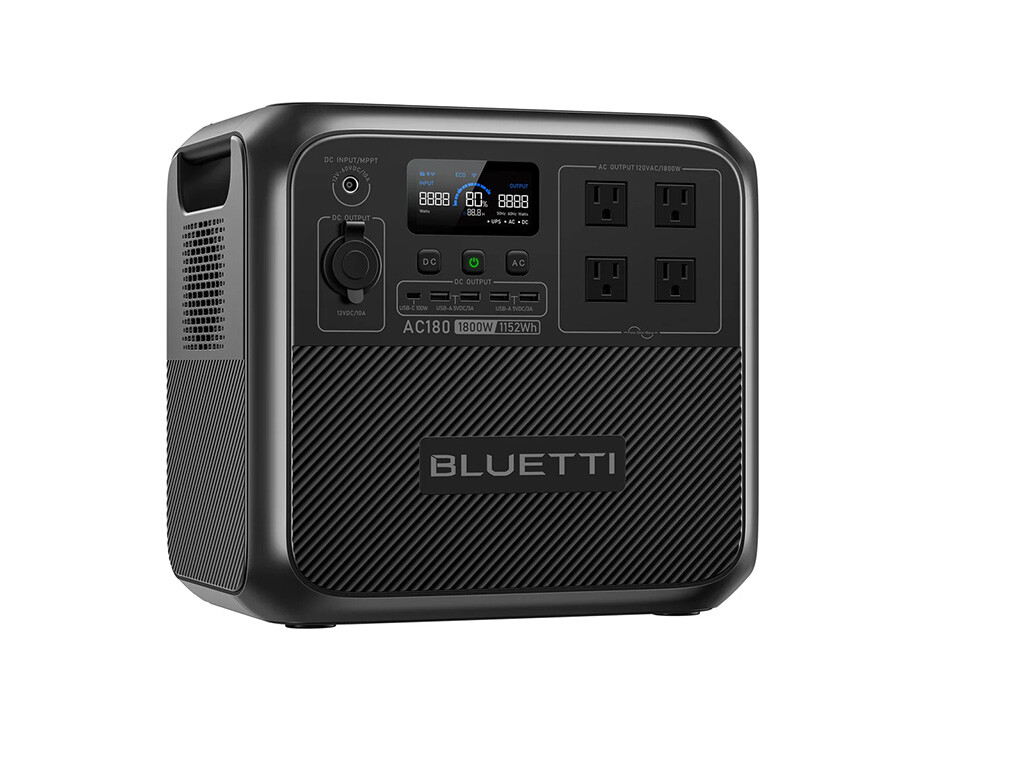
BLUETTI AC180 |
AC180 on Bluetti AC180 on Amazon |
Get 5% off most EcoFlow orders with the discount code SOLARWAY5OFF.
Detailed Comparison: EcoFlow DELTA 3 Plus vs. Bluetti AC180
We’ve done the high-level view. Now it’s time to look at the details of these power stations. After reading this, you’ll be able to know what is right for your needs. We’ll help you figure out what these power stations can run and for how long, plus the best ways to charge them.
We also have a big comparison chart for these two models, as well as a place where you can choose from a long list of power stations. You can see how any power station from EcoFlow, Bluetti, Anker, or Jackery compares to these two options.
- Battery Details
- Outlets and Inverter
- Charging Speeds
- Weight and Dimensions
- User Manuals
- Full Comparison Charts
You can see our article on How to Understand Power Station Specs for useful background info.

Battery Differences: How Long Do They Last?
The battery determines how long the power station will run your devices. Larger batteries also take longer to recharge.
The most significant way that the DELTA 3 Plus is different from the AC180 is the battery. The EcoFlow can use an extra external battery to increase its total capacity. By using the DELTA Pro 3 Extra Battery, you can get over 5kWh of total battery capacity to use with the DELTA 3 Plus.
The Bluetti AC180 does not have external battery packs to use. Other Bluetti models do, such as the larger AC200MAX. That means you’re stuck with the internal Bluetti battery and can’t expand it.
As it turns out, that’s not such a bad thing. The Bluetti AC180’s internal battery is 1,152Wh, bigger than the EcoFlow’s 1,024Wh. And if you want an even bigger internal battery, the Bluetti AC180P bumps that up to 1,440Wh. It’s identical to the AC180 otherwise.
This is a choice between serious expansion with an external battery or a larger internal battery.
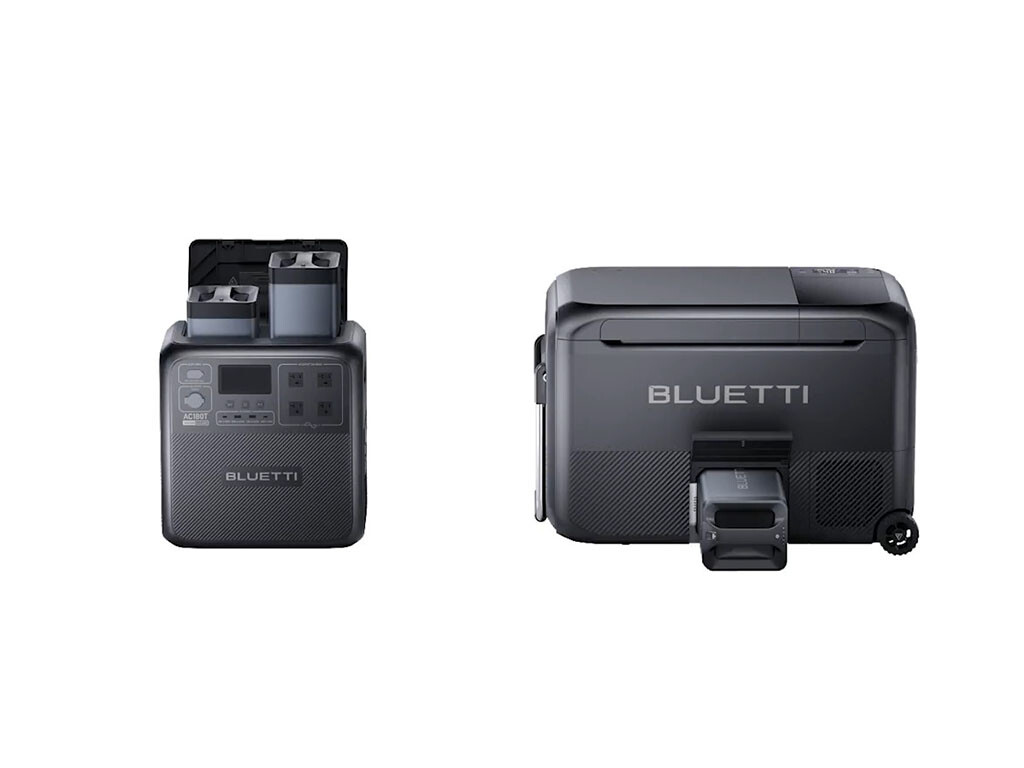
Bluetti also has the Bluetti AC180T with its unique SwapSolar battery technology. Read our full review here. This power station uses two removable battery packs which can run other Bluetti devices, like its portable fridge. The only downside of the AC180T is that you lose the wireless charging pad found on the AC180 and AC180P.
How long can these batteries last? That depends on the devices and the total amount of watts they pull. Here are some examples:
- EcoFlow’s 1,024Wh: Can charge a 10Wh phone about 80 times
- Bluetti’s 1,152Wh: Can charge a 10Wh phone about 90 times
Now let’s consider a home backup situation with a full-size fridge, some lights, a TV, and some phones/tablets. These devices use around 500W in total. Both internal batteries will only last about two hours. If you use the giant EcoFlow Extra Battery to get 5kWh total, then you can plan on about 8 hours! There’s no doubting the extra runtime of EcoFlow’s modular battery ability.
Both brands use LiFePO4 battery types in these power stations, which are well known as the best batteries for longevity. The DELTA 3 Plus is rated higher at >4,000 cycles with at least 80% capacity. You can charge and discharge this power station for over 10 years and it will still hold a charge well. The Bluetti is also long-lasting, but only at >3,000 cycles or about 8 years. Both will continue to work after this time, just with less capacity.
Battery Verdict: The modular expansion of the EcoFlow DELTA 3 Plus goes far beyond, giving you a lot more potential runtime. Bluetti not only has a larger internal battery, but the brand also offers two nearly-identical models with even bigger internal batteries.
| Product | EcoFlow DELTA 3 Plus | BLUETTI AC180T | BLUETTI AC180P | BLUETTI AC180 |
|---|---|---|---|---|
| Battery | 1,024Wh | 1,433Wh | 1,440Wh | 1152Wh |
| Battery (System Max) | 5,120Wh | 1,433Wh | 1,440Wh | 1152Wh |
| Warranty | 5 years | 5 years | 5 years | 5 years |
| Battery Type | LiFePO4 / LFP | LiFePO4 / LFP | LiFePO4 / LFP | LiFePO4 / LFP |
| Battery Cycles | >4,000 | >3,000 | >3,000 | >3,000 |
| Wireless Charging Pad | – | – | 1x15W | 1x15W |
| Buy Now | Buy D3P | Buy AC180T | Buy 180P | Buy AC180 |

Outlets and Inverter: What Can These Power?
Another crucial element is verifying the power station can provide the power you need at one time. You also need the right amount of outlets and ports for your devices.
DC Outlets: USB, Wireless Charging, Other Ports
It’s ideal to use the DC outputs when possible, like the USB ports. This maximizes the battery capacity by avoiding inverter loss. Both of these power stations have a lot of DC outputs. Here’s a quick breakdown of the differences between the EcoFlow DETLA 3 Plus and the Bluetti AC180:
- Bluetti has double USB-A ports (4 vs. 2) but fewer USB-C ports (1 vs. 2)
- Bluetti has a wireless charging pad
- EcoFlow has two 5521 DC ports (barrel plugs)
This is a bit of a toss up and really depends on your needs. Bluetti’s wireless charging pad is hard to pass up. No worrying about having any cable around. But the extra USB-C port on the EcoFlow plus the two barrel plug connectors can also be useful.

AC Inverter and Outlets
For AC power, the power inverter’s rating and number of AC outlets is what matters most. The inverter changes the DC energy from the battery into AC power found in normal household outlets (110V/120V).
The higher the wattage of the inverter, the more powerful devices it can run. These two power stations have a 1,800W power inverter continuous rating. You can run things like a 500W fridge, a 1,000W microwave, or a 1,500W induction cooktop. But you cannot run a 3,000W air conditioner, no matter how much battery charge it has. You also can’t run the induction cooktop and the fridge together.
EcoFlow has 6 outlets though. On the other hand, Bluetti only has 4.

The EcoFlow DELTA 3 Plus has a higher peak rating at 3,600W compared to Bluetti AC180’s 2,700W. This can be needed for certain appliances during startup. It’s a very short moment of power. EcoFlow also has a specialized X-Boost technology that allows for extended use at a higher wattage, but it does so by lowering the voltage. You can’t use it for sensitive electronics.
We encourage you to buy the power station based primarily on the continuous rating. While the peak rating is important for some devices, it’s always best to stay well under the maximum limits of any power inverter.
Power stations can now also be used as an uninterruptible power supply (UPS). This allows you to plug the power station into a wall outlet to constantly deliver power to critical equipment like your computer or a medical device. When there’s an outage, it will quickly switch to battery power to keep your device powered on. The shorter the transfer time, the more likely your device will avoid rebooting (and having data loss or damage).
The EcoFlow has a much better time of <10ms. This is a respectable transfer time that matches many dedicated UPS devices. Bluetti has a <20ms transfer time. This is obviously not a huge difference in the grand scope of things. But that extra 10ms might cause your computer to reboot. If the UPS function is a priority for you, stick with the EcoFlow.
Inverter and Outputs Verdict: The AC inverter is similar for both power stations. The EcoFlow DELTA 3 Plus has a higher surge rating, plus an extra USB-C port and 5521 connectors. Bluetti has two more USB-A ports and a wireless charging pad. It’s tough to call a clear winner here.
| Product | EcoFlow DELTA 3 Plus | BLUETTI AC180 |
|---|---|---|
| AC Output | 1,800W | 1,800W |
| AC Output Peak | 3,600W | 2,700W |
| 120V Outlets | 6 | 4x15A |
| UPS / EPS | 10ms | 20ms |
| USB-A Ports | 2x36W | 4x15W |
| USB-C Ports | 2x140W | 1x100W |
| DC 5521 (Barrel Plug) | 2x38W 3A | – |
| Cigarette Lighter | 1x126W | 1x120W |
| Wireless Charging Pad | – | 1x15W |

Charging Speeds
No matter the size of the battery, it won’t last forever. The charging speeds of any power station are something to pay close attention to, especially if you want to generate off-grid electricity with solar panels or fuel generators.
Both the DELTA 3 Plus and the AC180 have super-fast AC charging rates. They’ll fill the entire internal battery in about an hour or less.
The solar inputs are not the same. And this is one of the main reasons we prefer the EcoFlow DELTA 3 Plus over the Bluetti AC180. Here’s the difference:
- EcoFlow: 1,000W solar spread over two inputs with 60V/15A maximum
- Bluetti: 500W solar through one input with 60V/12A maximum
In practical terms, this means you can recharge the internal battery of the EcoFlow in about an hour with peak sunlight and 1,000W of solar panels. However, if you add the external battery and have 5kWh to recharge, then it’s a whopping 6 hours of peak sunlight. This may be more than what’s available in an entire day. It’s super fast for the internal battery but not quite sufficient for the biggest extra battery bank.
The Bluetti will take closer to 3 hours to charge from solar.

You can also charge your power stations while driving. Both power stations can use the car cigarette lighter port for a cheap and slow power source. But that usually only has about 120W, which means nearly 10 hours to recharge either option.
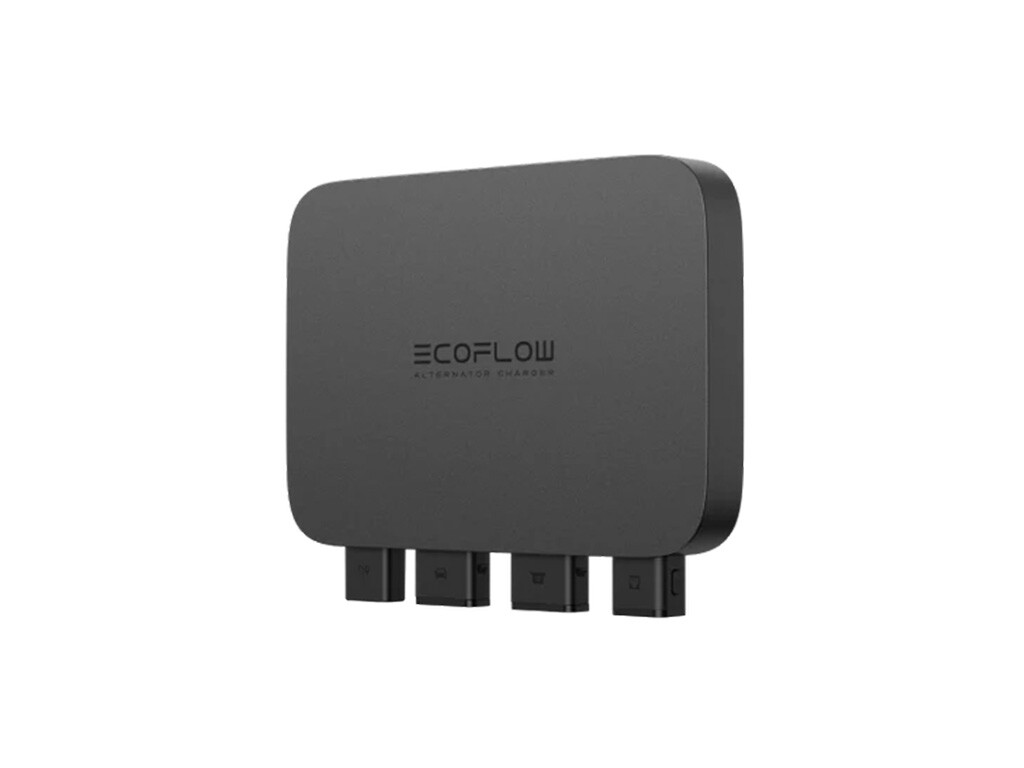
This is an area where EcoFlow has a trick up its sleeve. The EcoFlow 800W Alternator Charger provides very fast charging while driving. By using a direct connection to your car’s electrical system, you can pull up to 800W of it. And recharge in less than 2 hours.
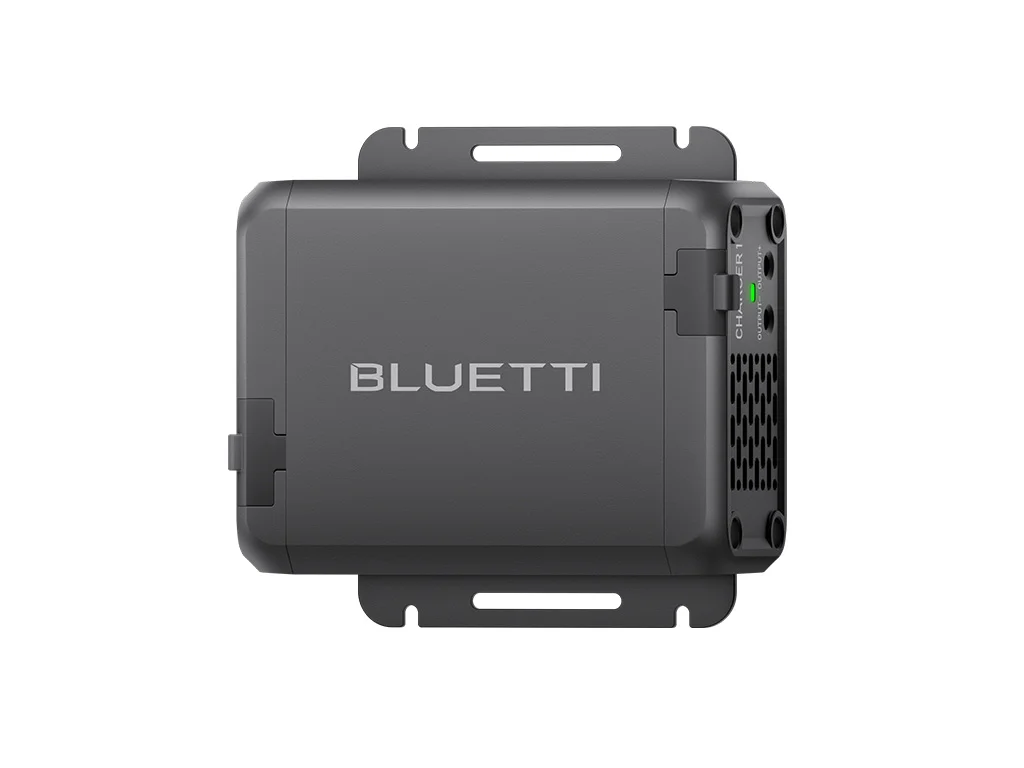
You can also use the Bluetti Alternator Charger 1 with both power stations. Its output mimics the same you get from solar panels through an MC4 connector and has adjustable voltage. You can use it with Bluetti power stations and EcoFlow power stations. But the Ecoflow Alternator Charger is a very slick device that offers two-way charging and has more intelligent features, it’s just only for select EcoFlow models though. The Pecron 500W Car Charger is another top choice and works with Bluetti and EcoFlow models.
Learn more about other universal car chargers for power stations.
Charging Verdict: With double the solar input and the available 800W Alternator Charger, the EcoFlow DELTA 3 Plus has the charging battle easily won. On the other hand, Bluetti has nearly identical AC charging (about an hour) and less than 3 hours from solar.
| Product | EcoFlow DELTA 3 Plus | BLUETTI AC180 |
|---|---|---|
| AC Input | 1,500W | 1,440W |
| AC Recharge Hours (Est.) | 0.8h | 1h |
| Solar Input | 1,000W | 500W |
| Solar Recharge Hours (Est.) | 1.2h | 2.8h |
| Solar Input 1 Watts | 500W | 500W |
| Solar Input 1 Volts Min | 11V | 12V |
| Solar Input 1 Volts Max | 60V | 60V |
| Solar Input 1 Amps | 15A | 12A |
| Solar Input 2 Watts | 500W | – |
| Solar Input 2 Volts Min | 11V | – |
| Solar Input 2 Volts Max | 60V | – |
| Solar Input 2 Amps | 15A | – |
| Buy Now | Buy D3P | Buy AC180 |
|
EcoFlow 800W Alternator Charger |
EFAC on EcoFlow EFAC on Amazon |
|
BLUETTI 560W Alternator Charger 1 |
Charger on Bluetti |

|
PECRON 500W Car Charger for Cars, RVs, etc. |
Buy on Pecron |
Get 5% off most EcoFlow orders with the discount code SOLARWAY5OFF.

Weight and Dimensions
The “portable” aspect of portable power stations can mean a lot. Did you know that some heavy-duty power stations weigh over 100lbs (45kg)?! When a hand truck or dolly is required, that doesn’t always suffice.
Here, we don’t have to worry about that. These are both fairly light power stations that most people can easily carry. But they aren’t identical.
The EcoFlow DELTA 3 Plus is an updated model that has greatly reduced the size and weight of previous versions. Weighing just over 25lbs (11kg), you can likely carry it with one hand. It’s about the size of a large shoebox.
The Bluetti AC180 isn’t so bad, but it does weigh more at just over 35lbs (15kg). Its dimensions are pretty similar, but just ever so slightly bigger.
The only catch is that if you are adding in the EcoFlow extra battery, there can be a lot of weight. The biggest DELTA Pro 3 Extra Battery weighs 72lbs (33kg). You can use other EcoFlow Extra Batteries that are smaller and lighter.
Weight and Dimensions Verdict: EcoFlow DELTA 3 Plus is smaller and lighter, but not if you add an external battery pack. The Bluetti is still only about 35lbs (15kg) and nearly the same size.
| Product | EcoFlow DELTA 3 Plus | EcoFlow DETLA Pro 3 Extra Battery | BLUETTI AC180 |
|---|---|---|---|
| Weight (lbs) | 27.6lbs | 72lbs | 36.2lbs |
| Weight (kg) | 12.5kg | 33kg | 16.4kg |
| Dimensions (in) | 8.0×15.7×11.2in | 27.3×11.6×8.5in | 13.4×9.7×12.5in |
| Dimensions (mm) | 202x398x284mm | 694x295x215mm | 340x247x317mm |
| Buy Now | Buy D3P | Buy Now | Buy AC180 |
| Buy on Amazon | Buy on Amazon | Buy on Amazon | AC180 on Amazon |

User Manuals
Here are links to the official user manuals for these two power stations:
| Product | EcoFlow DELTA 3 Plus | BLUETTI AC180 |
|---|---|---|
| User Manual | User Manual | User Manual |
Final Verdict
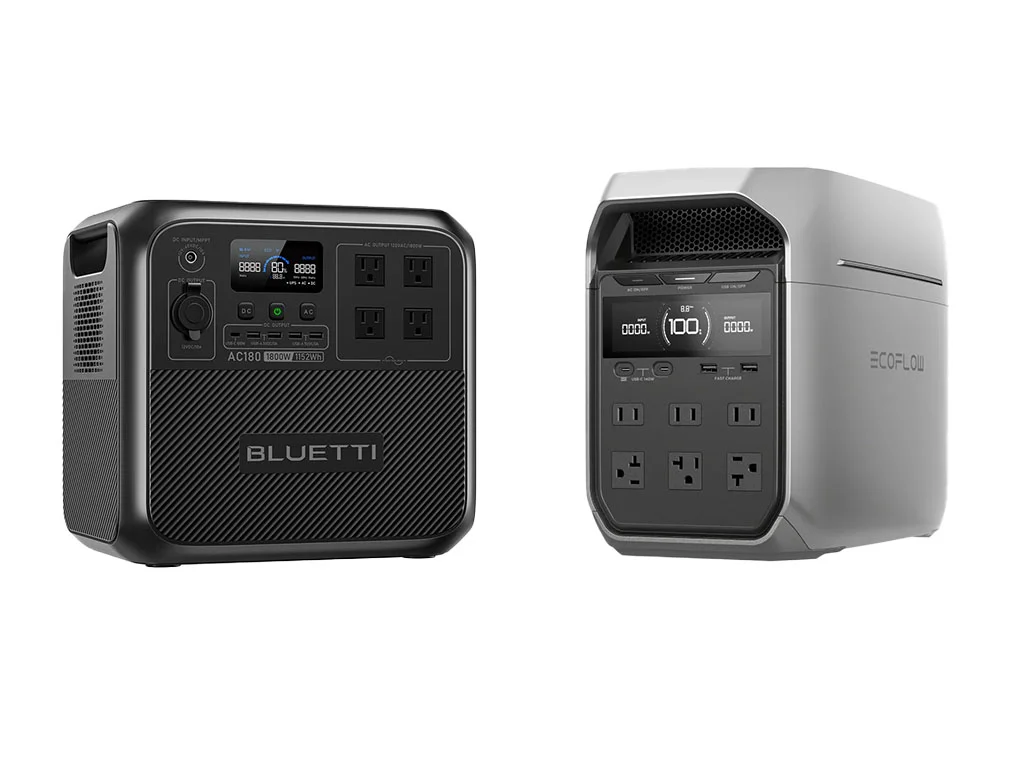
It’s hard to deny that EcoFlow DELTA 3 Plus comes out ahead of the Bluetti AC180. With the available external battery packs, faster solar charging, and quicker UPS transfer time, it brings big power wherever you need it.
Yet this isn’t a complete blowout. There are many reasons to choose the Bluetti AC180. It has a larger internal battery (especially if you go with the AC180P or AC180T), plenty fast enough charging, and a wireless charging pad. And it still has <20ms UPS switchover time.
These are very similar power stations overall. Both have a 1,800W AC inverter, about 1kWh internal battery, a handful of USB ports, and plenty of AC outlets. And most importantly, they’re both built by excellent brands known to produce some of the best power stations on the market. Both are backed by a 5-year warranty.
Which one is right for you?
That mostly depends on whether or not you want to use an external battery pack or more than 500W of solar. Both of these things cost more money. And you may or may not need them. Even the EcoFlow Alternator Car Charger is great, but also another device to buy. And if you do get these add-ons, then the EcoFlow weight savings goes out the window.
Final Verdict: EcoFlow’s battery expansion potential, double solar inputs, and quicker UPS time give it the edge over the Bluetti AC180. Yet this Bluetti is still an premium power station with similar specs. It even has a larger internal battery and a wireless charging pad.
|
|
EcoFlow DELTA 3 Plus |
D3P on EcoFlow D3P on Amazon |
|
|
BLUETTI AC180 |
AC180 on Bluetti AC180 on Amazon |
Comparison Charts: EcoFlow DELTA 3 Plus vs. Bluetti AC180
There are two parts to this section. One where we list the entire specifications. And a second spot where you can compare all of the power stations in our database, including those from EcoFlow, Bluetti, Anker, Jackery, and BougeRV.
Full Specs and Comparison Chart
Here is the detailed comparison chart for the specs of the DELTA 3 Plus and AC180:
| Product | EcoFlow DELTA 3 Plus | BLUETTI AC180 |
|---|---|---|
| Battery | 1,024Wh | 1152Wh |
| Battery (System Max) | 5,120Wh | 1152Wh |
| AC Output | 1,800W | 1,800W |
| AC Output Peak | 3,600W | 2,700W |
| AC Input | 1,500W | 1,440W |
| AC Recharge Hours (Est.) | 0.8h | 1h |
| Solar Input | 1,000W | 500W |
| Solar Recharge Hours (Est.) | 1.2h | 2.8h |
| Warranty | 5 years | 5 years |
| Weight (lbs) | 27.6lbs | 36.2lbs |
| Weight (kg) | 12.5kg | 16.4kg |
| Dimensions (in) | 8.0×15.7×11.2in | 13.4×9.7×12.5in |
| Dimensions (mm) | 202x398x284mm | 340x247x317mm |
| Solar Input 1 Watts | 500W | 500W |
| Solar Input 1 Volts Min | 11V | 12V |
| Solar Input 1 Volts Max | 60V | 60V |
| Solar Input 1 Amps | 15A | 12A |
| Solar Input 2 Watts | 500W | – |
| Solar Input 2 Volts Min | 11V | – |
| Solar Input 2 Volts Max | 60V | – |
| Solar Input 2 Amps | 15A | – |
| Battery Type | LiFePO4 / LFP | LiFePO4 / LFP |
| Battery Cycles | >4,000 | >3,000 |
| 120V Outlets | 6 | 4x15A |
| UPS / EPS | 10ms | 20ms |
| USB-A Ports | 2x36W | 4x15W |
| USB-C Ports | 2x140W | 1x100W |
| DC 5521 (Barrel Plug) | 2x38W 3A | – |
| Cigarette Lighter | 1x126W | 1x120W |
| Wireless Charging Pad | – | 1x15W |
| Connectivity | WiFi / Bluetooth | WiFi / Bluetooth |
| User Manual | User Manual | User Manual |
| Buy Now | Buy D3P | Buy AC180 |
| Buy on Amazon | Buy on Amazon | AC180 on Amazon |

Compare Any Power Station
Now it’s time for you to choose the comparison. Stick to the two we’ve talked about and see how they compare to ones from Jackery or Anker. Or flip the tables and look at any on this extensive list.
Choose up to 3 power stations from the drop-down menus. Then pick the spec group you want to see. When you click the button, a table will populate with the information you request. We’re very proud of this tool and are happy to have you share it or bookmark it for later.
Select Power Stations
Select up to three power stations to compare:
Wrap Up
In this midrange power station comparison, it’s a close call since they both have similar specs and come from top-tier brands. Yet EcoFlow DELTA 3 Plus sneaks ahead of the Bluetti AC180 by offering external battery packs, double the solar charging speed, and faster UPS switching. On the other hand, if you want a larger internal battery or a wireless charging pad, the Bluetti AC180 (or AC180P with an even larger battery) is still a great choice.
Not quite convinced? Check out our individual reviews of the EcoFlow DELTA 3 Plus or Bluetti AC180T. Or head over to our Product Guide page for more power station information.


