
Any solar powered system starts with one essential step: calculating how many solar panels you need. If you get the wattage or number of solar panels wrong, you may not have enough energy to power your devices. Or you’ll waste money on panels you don’t need.
Let’s solve this problem. With basic information and a simple calculation, you can figure out how many solar panels you need.
It doesn’t matter if you want to power your home, put solar panels on an RV, or bring electricity tent camping, the calculation is the same. After reading this, you’ll have the solar panel calculator you need. And the ability to understand how many solar panels you need.
We carefully select the products and services we link to. If you buy through our links, we may earn a commission. There’s no extra cost to you and it helps us provide this information.

Solar Panel Calculator
You need the amount of solar panels that will generate enough electricity for the devices you want to run. Let’s get right to it and understand the solar panel output calculation.
The basis of this calculation is matching your energy use to solar panel sizes. Energy use is measured in Watt-hours (Wh). Solar panel sizes are measured in Watts (W), which is a rate of electrical flow. We’ll use your energy use in Watt-hours to determine how many Watts of solar panels you need.
Here’s the solar panel calculation:
- Figure out how many daily Watt-hours (Wh) you will use, then add ~20% cushion to it
- Estimate the number of peak sunlight hours in your area:
- Sunny southern US states = 5 to 7 hours
- Stormy or northern states = 2 to 3 hours
- Average US state = ~4
- Divide your daily Wh by the sunlight hours to find the amount of solar panels you need in Watts
That is all it takes to determine how many watts of solar panels you need! In a moment, I’ll walk you through how to get the daily Wh for the first step.
Once you know your target wattage, it’s time to shop for solar panels. Look at the cost per watt and try to get larger panels to avoid running too many wires/connectors. Once you decide on panels, divide the total watts you want by the watts of each panel. This tells you exactly how many solar panels you need.
Caution: Calculating electrical demands and solar panel energy is not a perfect science. It’s impossible to perfectly predict your energy use, sunlight hours, or system efficiency. It’s best to overestimate your energy use and underestimate your sunlight hours.
Solar Waypoint’s Solar Panel Calculator Download
Find Solar Waypoint’s Solar Panel Calculator here! To use it, click “File” then “Make a copy.” Fill in the green cells and it will automatically calculate the watts of solar panels you need!
Here is a static screenshot of what it looks like:


Common Solar Panel and Solar System Sizes
We’ll walk through calculating your energy needs soon. But first, let’s see how many solar panels people generally use. Keep in mind that these are very generic amounts of solar panels. Your needs may be different depending on your sunlight and energy needs.
Fully Solar-Powered Home:
- ~8,000 to 10,000W of solar panels can usually meet the average US home energy consumption.
- Using large 400W solar panels, this is equal to 20 to 25 solar panels.
- Larger homes, ones in stormy regions, or those with high energy consumption might need more, going up to ~30,000W.
Home Battery Backup With Solar Power
- ~500 to 5,000W is reasonable for most home battery backup systems.
- Rely on the battery first. Then add as much solar as you need to power critical devices constantly.
- Your battery size and the time you want to have backup power are two major factors as well.
Solar Powered RV or Campervan
- ~2,000 to 3,000W is a powerful solar array for an RV that can usually power every appliance. Equal to about four to seven 400W solar panels.
- ~500 to 1,000W should power most lights, outlets, and small RV appliances. This is two to four 250W panels.
- Pair this with the right solar generator and you’ll easily create a solar powered RV.
Tent Camping Electricity
- ~100W to 500W of solar panels is usually enough. One folding solar panel can provide this.
- One solar panel and a solar generator creates an excellent tent camping electricity package that can power your entire adventure.
Off-Grid Living
- ~500W to 3,000W or more for an off-grid electrical system with low energy needs.
- Depends on what electrical devices you want to power and how crucial it is that they provide continuous power throughout the year.

|
Renogy 100W Solar Panel |
Buy on Renogy Buy on Amazon |

|
Renogy 200W Solar Panel |
Buy on Renogy Buy on Amazon |
|
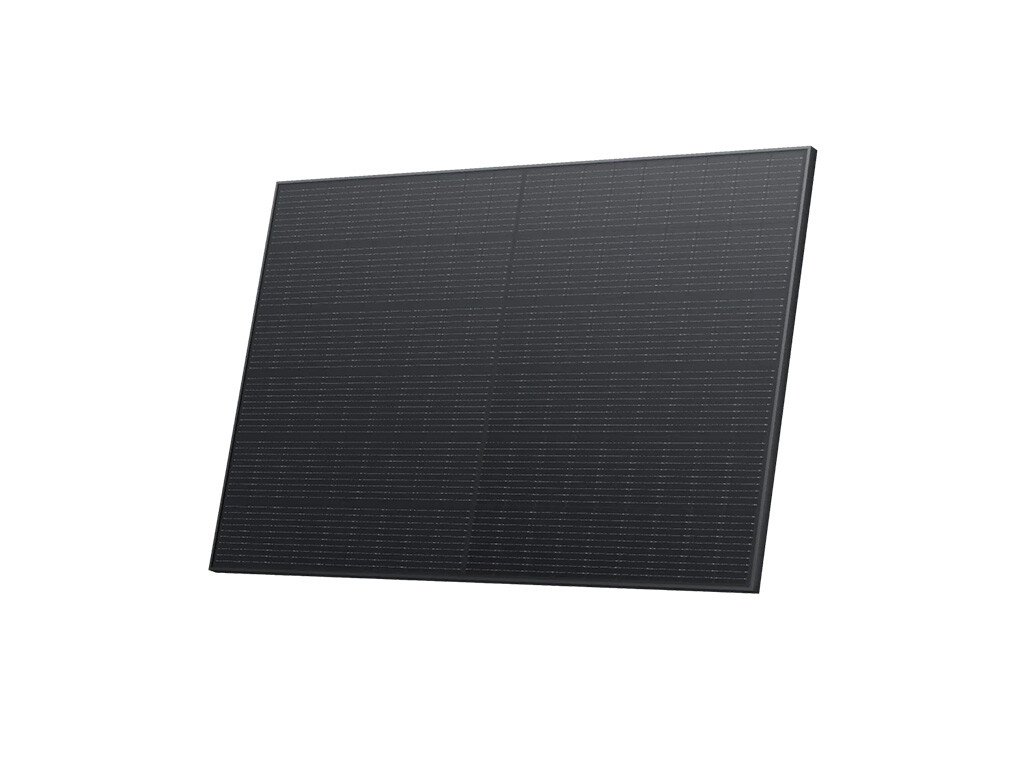
EcoFlow 400W Rigid Solar Panel |
Buy on EcoFlow Buy on Amazon |

Determining the Electrical Load: What Devices?
The point of a solar system is to power your things. Calculating your solar panel needs starts with figuring out how much total energy you’ll consume.
You need to find your daily Watt-hour usage. When you know how much electricity you plan on using, you can use the solar panel calculator.
There are three ways you can calculate how much power you plan on using:
- History: Use a previous energy bill (if you have one)
- Rough estimates: See what people in similar situations use
- Precise calculations: Add up your devices

Historical Energy Use: Energy Bills
If you have one, your past energy bill will tell you how much electricity you consume each month.
Look for the monthly kilo-watt-hours (kWh) consumed.
If you want to cover 100% of your needs, look for the month with the most energy usage. For many people, this happens in the summer due to air conditioner use. That’s typically the device that consumes the most electricity.
You don’t have to use 100%. Want to lower your bill? Or provide backup power for essential devices? Use a lower percentage, perhaps 50% or 80% of your monthly kWh consumed.
Whatever you come up with, this kWh tells you how much energy you need.
To convert this monthly kWh to daily Wh, just divide by 30 and multiply by 1,000. Then plug that daily Watt-hour into the solar panel calculator.
Many solar panel companies and professionals will use this calculation:
- Find annual kWh on energy bill
- Divide by your area’s “production ratio” (typically 1.1 to 1.7)
This is an easy calculation for how many solar panels you need. But it’s not perfect.
First, the “production ratio” is an overly complicated industry term. It’s just a fancy/confusing way to measure sunlight hours. Second, using the annual figure means it might not meet your highest usage month. If you want your air conditioner to run 100% on solar, you need to look at the monthly usage instead.

Rough Estimates: Learning from Other Solar Panel Users
Thousands already use solar panels. You can use their experience to understand how many solar panels you need.
kWh per square foot provides a reliable general estimate. In many US homes, this is somewhere between 0.45 and 0.8 kWh per sq ft.
0.5 kWh per sq ft is a reasonable average. If you have “normal” energy use, multiply your home’s square footage by 0.5.
Here’s some examples for that energy calculation:
- 500 sq ft home needs about 250 kWh per month
- 1,000 sq ft = 500 kWh
- 2,000 sq ft = 1,000 kWh
- 3,000 sq ft = 1,500 kWh
If you run an air conditioner very often, have a large electric water heater, or use other high-powered electrical devices, you may want to use 0.7 or 1 kWh per sq ft instead. So a 1,000 square foot home may use 700 to 1,000kWh of energy.
Many off-grid houses are built with low electricity use in mind. They can might use ~0.25 kWh per sq ft or lower. Around 1,000W to 3,000W of solar panels can power many off-grid living situations.
RVs usually have some energy-intensive appliances. If you just want to power lights and outlets, 500W can be sufficient. But to use your air conditioner without shore power, you might need to fill your entire open roof areas with solar, perhaps up to 1,500W or more.
The energy use of campervans varies greatly. But a typical campervan has anywhere from 300W to 1,500W of solar, depending on electrical appliances and desired usage away from shore power. Battery size also plays a major factor. As well as location.

Precise Calculations: Best for Off-Grid Living, RVs, Campervans, and Tent Camping
The best way to figure out the exact amount of solar panels you need is to add up the demands from each device you want to power. It can be tedious, but it’s the most reliable way to calculate energy needs.
This is especially useful for off-grid living, RVs, campervans, and tent camping. Since these use a variety of appliances, the electrical needs are not consistent. They can be very different from one person to another. It all depends on what you want to power and for how long.
Here’s how to precisely determine how many solar panels you need for your house, RV, campervan, tent camping, or off-grid living situation:
- Identify the consumption rate of each device in Watts
- Identify how many hours you want to run the device each day
- Multiple your device’s Watts by the amount of hours to get your daily Wh for each device
- Add together all of your devices to find the total daily Wh of electricity
- Plug that into the solar panel calculator
This sounds tough. But you’ll only have to do this once, then you’ll have an amazing piece of information to work with. It is worthwhile if you want the most accurate solar panel calculation.
There are a few difficult aspects to this, including:
- Many devices do not pull continuous energy, even if they’re on. Refrigerator compressors cycle on and off. Portable devices like phones and laptops only get charged as needed.
- If you can’t find the wattage, look for the amps and volts. Volts times amps equals watts.
To get started, check out this Solar Waypoint: Watt Calculator Google Sheet. You cannot edit this copy. Create your own by clicking “File” then “Make a copy.” You can edit your copy.
Add all of your devices to calculate your daily Wh. It’s wise to overestimate your needs. Stormy days are not a good time to run out of battery for your fridge or entertainment devices.
Once you have your daily Wh estimate, go back to the solar panel calculator.

The Cost of Solar Panels
How much will your solar panels cost? That’s a number you can actually figure out now!
Here’s a full breakdown of how to figure out how much your solar panel system will cost:
- Determine daily Watt-hour of energy you want to use
- Calculate the total wattage of solar panels you need (daily Wh x 120% / sunlight hours)
- Figure out which solar panel size works for your budget and needs
- Divide total wattage by the individual solar panel wattage to see how many individual panels you need
- Multiply the number of panels by their price
- You have calculated the cost of your solar panels! Don’t forget to add wires, connectors, and mounts
Take a close look at step 3, figuring out which solar panel size to use. Larger sizes can usually increase efficiency and reduce the number of wires, connections, and mounts. But sometimes they can be overly expensive. Check the cost per watt of each solar panel (simply cost divided by watts) to make sure it’s not overly expensive.
For example, there are some giant 750 W solar panels available. But they’re not common and as such, are usually quite expensive at cost per watt. It can make a lot more sense to use common and affordable 400 W solar panels instead.
|
|
Renogy 100W Solar Panel |
Buy on Renogy Buy on Amazon |
|
|
Renogy 200W Solar Panel |
Buy on Renogy Buy on Amazon |
|
|
EcoFlow 400W Rigid Solar Panel |
Buy on EcoFlow Buy on Amazon |

|
Renogy 100W Portable Solar Panel |
Buy on Renogy Buy on Amazon |

|
Renogy 200W Portable Solar Panel |
Buy on Renogy Buy on Amazon |

|
Renogy 400W Portable Solar Panel |
Buy on Renogy Buy on Amazon |

How to Calculate Solar Panel Needs: Wrapping It Up
Once you figure out how much energy you’ll consume, it’s easy to calculate the solar panels you need. Once done here, you’ve taken a giant step forward toward solar energy independence. Getting your solar panels is now possible!
We strongly encourage you to overestimate your energy use and underestimate the sunlight hours. This isn’t an exact science. It’s hard to predict your exact sunlight, usage, and efficiency.
Once you’re done here, it’s time to figure out how to connect your panels. Series vs. parallel, voltage limits, and amperage limits are vital considerations. You can also use our Power Station Wizard, which will automatically figure out how many solar panels your power station can handle.