

Almost a decade and a half ago, Anker began producing portable power banks ready to charge small USB devices and phones while on the go. And now this company has grown into bigger shoes, including portable power stations like the Anker Solix F2000, ready to tackle much bigger energy needs and solar charging anywhere.
In this guide, we’ll walk you through the details and specs for the Anker Solix F2000. By translating the info into real-world terms, you’ll be able to understand what this power station can run and for how long. Plus, we’ll compare the Anker F2000 to similar power stations, pointing out the pros and cons of each unit.
Ready to see more details about the Anker F2000 power station? Let’s find out if it’s the one for you (or not).
We carefully select the products and services we link to. If you buy through our links, we may earn a commission. There’s no extra cost to you and it helps us provide this information.

Quick Overview: Anker Solix F2000
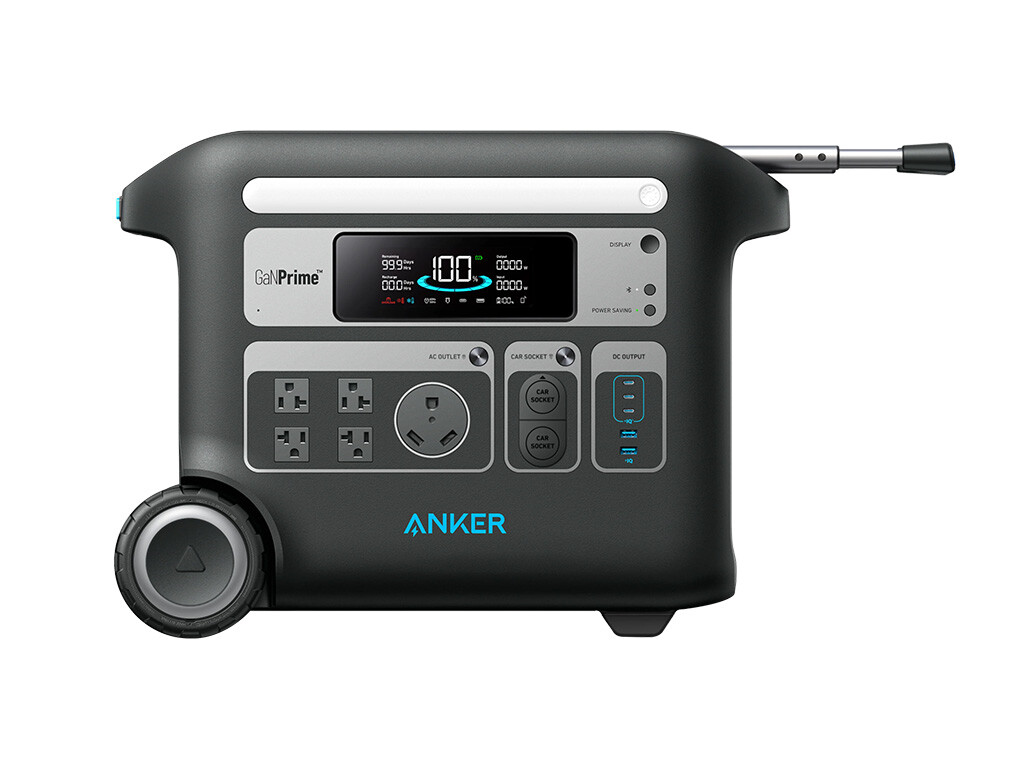
This portable power station falls toward the upper end of most options, without reaching extreme power (and price) levels. The Anker F2000, also known as the PowerHouse 767, is great for fairly large portable power needs. Thanks to its 30-amp outlet, it’s also one of the best choices in this segment for RV use.
The things that stand out on the Anker F2000 include:
- 2.4kW AC Inverter: Can power the vast majority of appliances, including microwaves, induction cooktops, and full-size fridges
- Up to 4kWh Battery Capacity: 2kWh internal battery with optional 2kWh external battery pack
- Fast Charging Rates: Less than 2 hours from AC outlets and ~2.5 hours from 1,000W of solar panels
- High-Amp Outlet and UPS Function: 30-amp outlet, 20ms UPS, and 3 USB-C ports are above all competitors
This combination of features and capabilities is hard to find. This Anker power station is ready to provide long-lasting power on your camping or RV adventures, but it can also serve very well as a home backup solution for the most important electronics (including fridge, TV, and other mid-size devices). If you want to power heavy-duty appliances like an air conditioner – or have a power station to provide days of home backup power – we recommend going up to the next size of heavy duty power stations.
While there are a lot of things to like about the F2000, there are a couple things we’d like to see improved. These include:
- Battery expansion potential could be higher
- No high-amp DC output or 5521 barrel plug is less than ideal
If these are a must for you, we have good news. The power stations compared to the Anker F2000 offer these options. But there are some tradeoffs. We’ll go through the fine details below, but here’s a quick look at how this midrange Anker power station compares to similar options from other brands:
- Bluetti AC200MAX: 8kWh battery possible and high-amp AC & DC, but slow AC charging and no UPS function
- EcoFlow Delta 2 Max: 6kWh battery possible, but lacks any high-amp outputs and only 30ms EPS
- Jackery Explorer 1000 Plus: Most affordable with 5kWh battery possible and very fast charging, but smaller battery and inverter
The Bluetti option is one that pulls our attention away from the F2000 the most, but the lack of UPS function can be a dealbreaker if you need it.
No other has the 20ms UPS transfer time, high-amp AC output, and fast charging speeds of the Anker Solix F2000. It’s a very capable and high-quality power station backed by a 5 year warranty from a brand you can trust.
|
Anker SOLIX F2000 (PowerHouse 767) |
Buy on Anker Buy on Amazon |
|
|
Anker SOLIX F2000 Solar Generator + 3 x 200W Solar Panel |
Buy on Anker |
AC Inverter: Covers Most Needs
The power inverter is a crucial part of any power station. It determines how much energy can flow out of the AC outlets at one time. The higher the rating in watts, the more powerful devices it can run. For example, a 1,000W inverter can’t run a 1,500W induction cooktop (regardless of battery level).
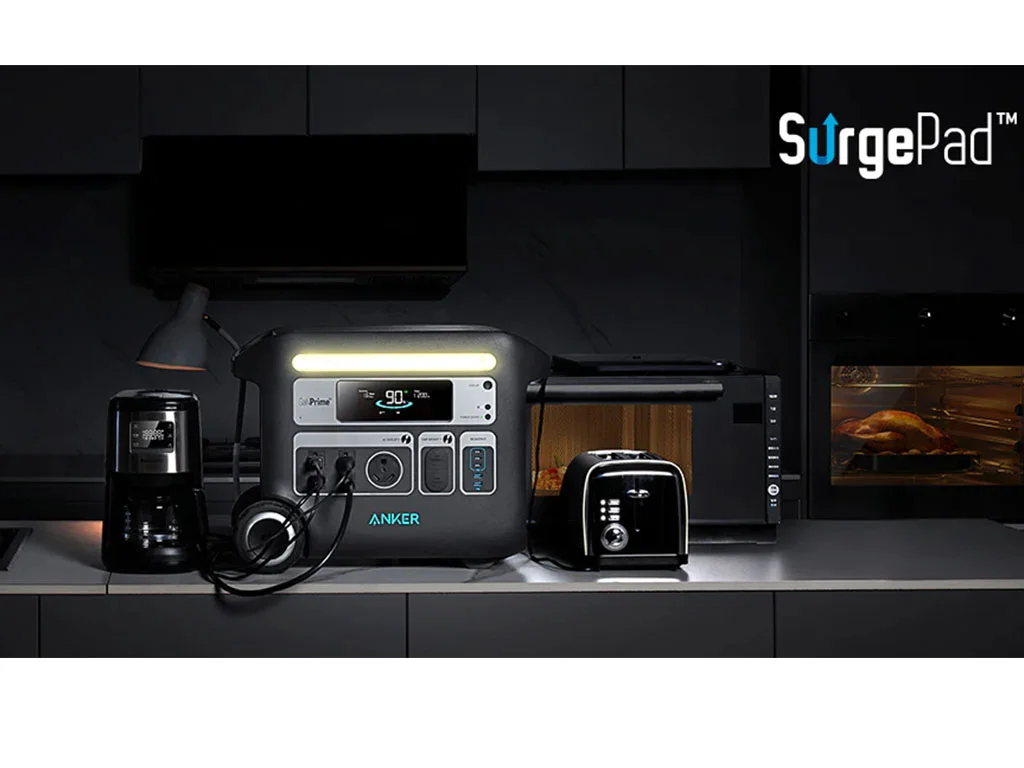
The Anker F2000 has a 2,400W AC pure sine wave power inverter. This is the best in class, only matched by the EcoFlow Delta 2 Max. And at this level, you can run almost any electronic device in your home or while on adventures. You can run many LED lights, your home fridge, and charge an entire bundle of small devices from this inverter. It can also handle most tools, microwaves, and even an induction cooktop.
On top of the inverter offering a lot of power, it has an integrated UPS function with 20ms or less transfer time. If you want to keep a critical device like a computer or medical equipment plugged in, the F2000 can do it. The UPS will pass through power from a wall outlet, and if that fails, switch over to internal battery within 20ms.
This inverter size is one that we think is basically ideal. The only catch is that if you do want to run a big 1,500W device, then you might have to stop powering other items at the same time. To run an entire home with a fridge and many lights, then throw on a load like a microwave, you’ll need a bigger inverter.
For portable power needs, it’s very likely that you’ll never have a problem. This can pretty easily handle a small fridge, charging devices, and running portable appliances without a problem.
Here are the Anker F2000 specs for the AC inverter:
| Product | Anker Solix F2000 / PowerHouse 767 |
|---|---|
| AC Output | 2,400W |
| AC Output Peak | 2,400W |
| 120V Outlets | 4x20A, 1x30A |
| UPS / EPS | 20ms |
| Buy Now | Buy Now |

Battery Specs
While the inverter is about maximum power, the battery is about how long you can power things for. You also want to look for the right type of battery that will keep a charge for many years. This Anker power station has a capable battery on both sides of this coin:
- 2,048Wh internal battery with available 2,048Wh BP2000 Expansion Battery
- LiFePO4 battery type rated for >3,000 charge/discharge cycles
The 2kWh F2000 battery can run a lot of devices for a long time. To give you a basic comparison, a cell phone battery is usually about 10Wh to 15Wh. So this can charge a phone about 160 times if it’s 10Wh. When you start stacking on other devices, you’ll see that the expansion battery can be useful.
Here’s some general power consumption rates per hour:
- 10Wh to 50Wh: Small chargers for phones and tablets; other small devices like lights and speakers
- 50Wh to 200Wh: Computers, televisions, and small refrigerators
- 200Wh to 500Wh: Full size fridges and large entertainment systems
- 500Wh and up: Induction cooktops, microwaves, blenders (things you usually don’t run for hours)
Let’s say you want to charge 5 phones while powering 5 lights, a full-size fridge, and a television for 3 hours. That’s about 1,100Wh of energy. So the internal battery can handle this pretty easily. You can run this group of electronics for almost double that time.
Compared to alternatives, the 2kWh internal battery is the same and the Bluetti and EcoFlow (Jackery is smaller). But all three alternatives have higher capacity potential through extra battery packs. If that’s likely your need, then we suggest the Bluetti AC200MAX since it has the highest 8kWh battery potential.
The other issue with the Anker extra battery is that it does not have independent charging. The Bluetti options do (200W or 500W each, depending on battery choice).
At the end of the day, the Anker Solix F2000 battery holds a lot of power and its ability to double with an external pack can be very useful. While it’s not the biggest around, it can be more than enough for many situations.
| Product | Anker Solix F2000 / PowerHouse 767 |
|---|---|
| Battery | 2,048Wh |
| Battery (System Max) | 4,096Wh |
| Warranty | 5 years |
| Battery Type | LiFePO4 / LFP |
| Battery Cycles | >3,000 |
| Buy Now | Buy Now |

Charging Rates
As you use any power station, you’ll need to replenish the power eventually. Hidden inside of each power station are charge controllers. These components pull power in and send it to the battery. And they determine the maximum charging rates.
What you want to look for is a good ratio between the charging rates and the battery size. The best power stations keep this to about a 2:1 ratio, which means you can charge the entire battery in around 2 hours.
The Anker F2000 charging rates are excellent, for both AC charging from a wall outlet and off-grid charging from sources like solar panels. It can use almost 1.5kW from a wall outlet and recharge in less than 2 hours. And if you get the maximum 1,000W of solar panels, about 2 and a half hours in peak sunlight will do the trick.
There’s really nothing to complain about with the Anker F2000’s charging rates. Even with the extra battery, it’s still less than 4 or 5 hours for a full recharge. The other options all have fast charging too, except the Bluetti AC200MAX’s AC charging rate. That’s a rough 5 hours just for the internal battery. Still not the end of the world, but much slower than most.
Here are the charging rate specs for the Anker F2000. The charging time is an estimate that may differ based on the battery protection measures (power stations usually slow down charging at 80% capacity to avoid battery damage).
| Product | Anker Solix F2000 / PowerHouse 767 |
|---|---|
| AC Input | 1,440W |
| AC Recharge Hours (Est.) | 1.7h |
| Solar Input | 1,000W |
| Solar Recharge Hours (Est.) | 2.5h |
| Solar Input 1 Watts | 1000W |
| Solar Input 1 Volts Min | 11V |
| Solar Input 1 Volts Max | 60V |
| Solar Input 1 Amps | 20A |
Weight and Dimensions
This segment of midrange portable power stations push the limits of portability. They have pretty large batteries and tons of features, which means that they need to be quite a bit larger than compact power stations. And somehow, they still manage to stay at a fairly decent weight.
The F2000 weighs 67.2lbs (30.5kg). It’s not something you’ll want to carry too far and some people might need help lifting it into a vehicle or on a shelf.
To make things a lot easier, there are integrated wheels and a pull-out handle. It’s similar to those found on some large coolers. And this can be extremely helpful. It’s also something that other brands simply do not offer, despite having very similar weights.
Here are the specs for the F2000’s weight and dimensions:
| Product | Anker Solix F2000 / PowerHouse 767 |
|---|---|
| Weight (lbs) | 67.2lbs |
| Weight (kg) | 30.5kg |
| Dimensions (in) | 20.7×15.5×9.8in |
| Dimensions (mm) | 525x395x250mm |
Outlets and Features
Finally, one thing you always want to be sure of is that your power station has the right amount of outlets and ports. And if you want to use it for high-power applications, you’ll also want to look for high-amp outputs. You can’t change these things about a power station. Like the power inverter, they limit how much energy you can use at one time, as well as how many devices you can plug in.
The Anker Solix F2000 has the best array of outlets and ports out of any in this class. Except for its lack of high-amp DC output. That’s the one glaring omission that many brands neglect. Bluetti AC200MAX is the only one that has that feature (and the high-amp AC too).
The F2000 still has the 30-amp AC output, perfect for RV use and powering a home transfer switch. It also comes with the most USB-C ports and an extra car cigarette lighter port.
Add in the UPS function and the fact it has WiFi and Bluetooth connections to the Anker app, and you have one full-featured power station.
While we would love to see a high-amp DC output, the F2000 still has a very attractive lineup of outlets and ports.
| Product | Anker Solix F2000 / PowerHouse 767 |
|---|---|
| 120V Outlets | 4x20A, 1x30A |
| UPS / EPS | 20ms |
| USB-A Ports | 2x12W |
| USB-C Ports | 3x100W |
| Other DC (Anderson or other) | – |
| Cigarette Lighter | 2x120W |
| Connectivity | WiFi / Bluetooth |
| Buy Now | Buy Now |

Anker F2000 Comparisons
We’ve constantly mentioned how the F2000 compares to other power stations, but now we’re going to take a closer look at the three best alternatives. You can find a lot more comparison articles on Solar Waypoint, as well as full comparison charts for each brand like Bluetti, EcoFlow, and Anker.
Here are the three power station alternatives that are closest to the Anker F2000:
- Bluetti AC200MAX: A very attractive model that may be a better choice for some people
- EcoFlow Delta 2 Max: Lacks high-amp output and only 30ms EPS
- Jackery Explorer 1000 Plus: Most affordable with smaller battery and inverter

Anker F2000 vs. Bluetti AC200MAX
If there’s one power station that gives the Anker F2000 a run for the money, it’s the Bluetti AC200MAX. It has very similar specs without any extra batteries (2kWh internal battery and 2.2kW inverter), but comes with a high-amp DC output, two 5521 barrel plug ports, and two wireless charging pads. And this is on top of the 30-amp AC output and USB ports.
Then when you add on extra batteries, the Bluetti AC200MAX goes well beyond the Anker F2000. While the Anker can only add one extra battery for 4kWh total, the Bluetti can add up to 2 extra batteries with a maximum capacity of 8kWh. There are two battery choices to use:
- BLUETTI B300 Battery: 3,072Wh and 200W solar input; up to 2 for 8kWh total
- BLUETTI B230 Battery: 2,048Wh and 500W solar input; up to 2 for 6kWh total
The 500W solar input for each of the smaller B230 is much better than the 200W of the larger B300. Something important for those that want solar power.
Speaking of charging rates, there are some ways the Bluetti AC200MAX vs Anker F2000 tilts the other direction. The Bluetti has only 500W AC charging, which is much slower than any other. And on top of that, this Bluetti does not have a UPS function of any sort. That can be a major problem if that’s your intended use (keep it plugged into the wall and powering a device constantly).
There are many reasons to choose the Bluetti AC200MAX over the Anker F2000. The DC output and 8kWh potential battery capacity are the top two. But you want to avoid it if AC charging or UPS function are part of your priorities.
Read more about the Bluetti AC2000MAX in our full guide. Here are detailed specs for Anker F2000 vs. Bluetti AC200MAX:
| Product | BLUETTI AC200MAX | Anker Solix F2000 / PowerHouse 767 |
|---|---|---|
| Battery | 2,048Wh | 2,048Wh |
| Battery (System Max) | 8,192Wh | 4,096Wh |
| AC Output | 2,200W | 2,400W |
| AC Output Peak | 4,800W | 2,400W |
| AC Input | 500W | 1,440W |
| AC Recharge Hours (Est.) | 4.9h | 1.7h |
| Solar Input | 900W | 1,000W |
| Solar Recharge Hours (Est.) | 2.7h | 2.5h |
| Solar Input (System Max) | 1,900W | 1,000W |
| Warranty | 5 years | 5 years |
| Battery Type | LiFePO4 / LFP | LiFePO4 / LFP |
| 120V Outlets | 5 total (4x20A; 1x30A) | 4x20A, 1x30A |
| UPS / EPS | – | 20ms |
| USB-A Ports | 2x15W; 2x18W | 2x12W |
| USB-C Ports | 1x100W | 3x100W |
| Other DC (Anderson or other) | 30A | – |
| DC 5521 (Barrel Plug) | 2x120W 10A | – |
| Cigarette Lighter | 1x120W | 2x120W |
| Wireless Charging Pad | 2x15W | – |
| Connectivity | WiFi / Bluetooth | WiFi / Bluetooth |
| Buy Now | Buy AC200MAX | Buy Now |
Anker F2000 vs. EcoFlow Delta 2 Max
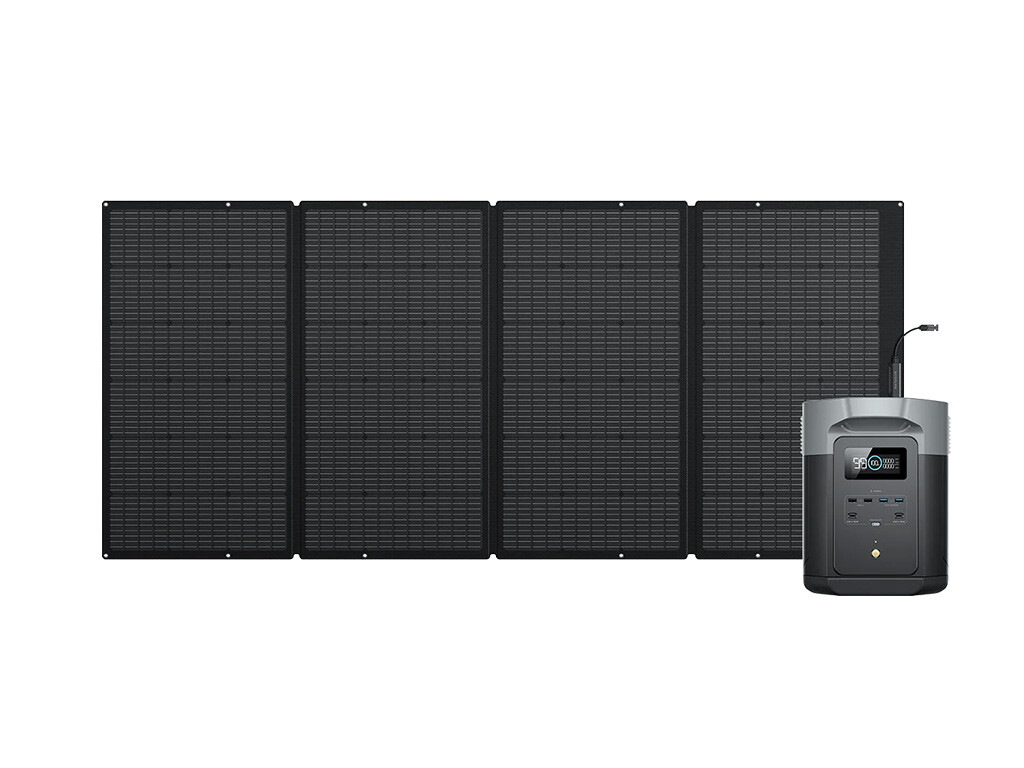
The EcoFlow Delta 2 Max is also better than the F2000 in regards to battery expansion. It can go up to 6kWh, right in the middle of the two. And still has the same 2kWh internal battery.
While the EcoFlow’s 2.4kW inverter matches the Anker as well, there are some noticeable differences in the outputs and ports. The Delta 2 Max does not have any high-amp output, AC or DC. This can be a major reason to stick with the F2000 (or the Bluetti AC200MAX) instead.
The EcoFlow has a 30ms EPS function. This means that it can be used as a type of UPS, but the long transfer time of 30ms might mean that computers, routers, and other devices will shutdown during the switch. The 20ms of the Anker is better, but still not the ideal 10ms or less.
One other nice feature of the EcoFlow compared to the Anker F2000 is that it’s solar specs provide a lot more room. It uses dual inputs with up to 60V and 15A. This makes it a lot easier to find solar panels to use with this power station.
The bottom line is that we prefer the Anker F2000 over the EcoFlow Delta 2 Max. This is mostly due to the high-amp AC output on the F2000, but also the better UPS time. If you don’t need a high-amp output and want the extra battery expansion and better solar input specs, then the EcoFlow Delta 2 Max is a good choice.
You can discover more in our guide to the EcoFlow Delta 2 Max.
| Product | EcoFlow DELTA 2 Max | Anker Solix F2000 / PowerHouse 767 |
|---|---|---|
| Battery | 2,048Wh | 2,048Wh |
| Battery (System Max) | 6,144Wh | 4,096Wh |
| AC Output | 2,400W | 2,400W |
| AC Output Peak | 4,800W | 2,400W |
| AC Input | 1,800W | 1,440W |
| AC Recharge Hours (Est.) | 1.4h | 1.7h |
| Solar Input | 1,000W | 1,000W |
| Solar Recharge Hours (Est.) | 2.5h | 2.5h |
| Warranty | 5 years | 5 years |
| Battery Type | LiFePO4 / LFP | LiFePO4 / LFP |
| 120V Outlets | 6 | 4x20A, 1x30A |
| UPS / EPS | 30ms (EPS) | 20ms |
| USB-A Ports | 4x12W/18W | 2x12W |
| USB-C Ports | 2x100W | 3x100W |
| Other DC (Anderson or other) | – | – |
| DC 5521 (Barrel Plug) | 2x38W 3A | – |
| Cigarette Lighter | 1x126W | 2x120W |
| Wireless Charging Pad | – | – |
| Connectivity | WiFi / Bluetooth | WiFi / Bluetooth |
| Buy Now | Buy D2M | Buy Now |

Anker F2000 vs. Jackery Explorer 1000 Plus
Our last comparison is the Jackery 1000 Plus vs. the Anker F2000. In general, this is a less expensive and less capable power station. But it’s still in the same ballpark and might be a good way to save some cash if you don’t need all the F2000 offers.
We considered using the Jackery 1000 v2 instead, but since it lacks battery expansion, the 1000 Plus is a more suitable comparison. If you don’t need that, the Jackery 1000 v2 can be worth checking out. It’s one of our favorite in the Jackery power station comparison charts.
In the Jackery 1000 Plus vs. the Anker F2000 comparison, these are the highlights:
- Jackery only has 1.3kWh internal battery but can expand up to 5kWh total (2kWh / 4kWh for the Anker)
- Jackery’s inverter is 2kW, is not a UPS, and does not have any high-amp outputs (2.4kW, 20ms UPS, and AC high-amp for the Anker)
The battery expansion and lower price (usually) make the Jackery worth checking out. But it simply doesn’t offer all the extra features of the F2000.
| Product | Jackery Explorer 1000 Plus | Anker Solix F2000 / PowerHouse 767 |
|---|---|---|
| Battery | 1,265Wh | 2,048Wh |
| Battery (System Max) | 5,056Wh | 4,096Wh |
| AC Output | 2,000W | 2,400W |
| AC Output Peak | 4,000W | 2,400W |
| AC Input | 1,800W | 1,440W |
| AC Recharge Hours (Est.) | 0.8h | 1.7h |
| Solar Input | 800W | 1,000W |
| Solar Recharge Hours (Est.) | 1.9h | 2.5h |
| Warranty | 3-5 years | 5 years |
| Battery Type | LiFePO4 / LFP | LiFePO4 / LFP |
| 120V Outlets | 3×16.7A | 4x20A, 1x30A |
| UPS / EPS | – | 20ms |
| USB-A Ports | 2x18W | 2x12W |
| USB-C Ports | 2x100W | 3x100W |
| Other DC (Anderson or other) | – | – |
| DC 5521 (Barrel Plug) | – | – |
| Cigarette Lighter | 1x120W | 2x120W |
| Wireless Charging Pad | – | – |
| Connectivity | WiFi / Bluetooth | WiFi / Bluetooth |
| Buy Now | Buy 1000 Plus | Buy Now |
Anker Solar F2000 Full Specs and User Manual
Here is a chart with the full specs and a link to the user manual for the Anker Solix F2000:
| Product | Anker Solix F2000 / PowerHouse 767 |
|---|---|
| Battery | 2,048Wh |
| Battery (System Max) | 4,096Wh |
| AC Output | 2,400W |
| AC Output Peak | 2,400W |
| AC Input | 1,440W |
| AC Recharge Hours (Est.) | 1.7h |
| Solar Input | 1,000W |
| Solar Recharge Hours (Est.) | 2.5h |
| Solar Input (System Max) | 1,000W |
| Warranty | 5 years |
| Weight (lbs) | 67.2lbs |
| Weight (kg) | 30.5kg |
| Dimensions (in) | 20.7×15.5×9.8in |
| Dimensions (mm) | 525x395x250mm |
| Solar Input 1 Watts | 1000W |
| Solar Input 1 Volts Min | 11V |
| Solar Input 1 Volts Max | 60V |
| Solar Input 1 Amps | 20A |
| Battery Type | LiFePO4 / LFP |
| Battery Cycles | >3,000 |
| 120V Outlets | 4x20A, 1x30A |
| UPS / EPS | 20ms |
| USB-A Ports | 2x12W |
| USB-C Ports | 3x100W |
| Other DC (Anderson or other) | – |
| Cigarette Lighter | 2x120W |
| Connectivity | WiFi / Bluetooth |
| User Manual | User Manual |
| Buy Now | Buy Now |
| Buy on Amazon | Buy on Amazon |
|
|
Anker SOLIX F2000 (PowerHouse 767) |
Buy on Anker Buy on Amazon |
|
|
Anker SOLIX F2000 Solar Generator + 3 x 200W Solar Panel |
Buy on Anker |
Wrap Up
As an upper midrange power station, the Anker Solix F2000 has what it takes to compete with the best. You can double the 2kWh battery with an external pack and its 2.4kW inverter can handle most needs. Tack on the 30-amp AC output and the 20ms UPS to see how it goes above and beyond.
The Bluetti AC200MAX is out top contender against the Anker F2000, mainly due to its higher battery capacity potential and high-amp DC output. But it lacks a UPS function and has a slow AC charging speed.
Now that you are a step closer to figuring out your power station, don’t forget to calculate how many solar panels you need. You can also see more information about this segment with all of our articles about the midrange power stations.