

Electricity away from outlets is no longer an expensive pipedream. Affordable and compact power stations can charge and run your devices anywhere. In this EcoFlow River 3 vs. Bluetti EB3A comparison, we put two of the most sought-after portable power stations against each other to see which is better.
In this power station guide, we’ll help you understand the features and performance of these two options. We’ll translate the technical jargon into real-world applications so you can figure out what these can power and how long they’ll last.
Let’s pull back the curtain to discover which power station is better, the EcoFlow River 3 or the Bluetti EB3A.
We carefully select the products and services we link to. If you buy through our links, we may earn a commission. There’s no extra cost to you and it helps us provide this information.
Quick Summary
When it comes to compact power station options, it’s a segment that’s especially littered with choices that aren’t worth your money. Our expert team has sorted through this crowded list to make sure your money is well spent.
As two of the industry’s top brands, we like a lot of power stations from EcoFlow and Bluetti. These two particular compact power stations offer a very similar list of features and value. The battery, outlets, and warranty length are close to identical. They both can even be controlled via an app.
Yet after digging deep, we found the EcoFlow River 3 is better than the Bluetti EB3A because:
- Newer and significantly smaller model with similar capabilities
- Advanced EcoFlow functions such as X-Boost and X-Guard
- Quiet performance with <20ms UPS function
This is a very close comparison. The Bluetti EB3A even has some features not found on the EcoFlow, such as:
- Wireless charging pad and two 5521 connections
- More powerful AC inverter and slightly larger battery capacity
- Faster solar charging speed specification

If the Bluetti has all of these while the EcoFlow doesn’t, why do we recommend the EcoFlow?
Unfortunately, the EB3A fan noise is excessive and there are enough reports of reliability issues to cause concern. Bluetti products are usually very well designed and trustworthy. The EB3A seems to be an exception with some known problems, particularly related to continued use of the UPS function and faults with the DC outputs. If you want to stick with Bluetti, we recommend the AB50B. It’s more powerful and expensive than these two though.
The EcoFlow River Series has a better reputation. The River 3 is a newer version replacing the River 2, but the new model has been put through the wringer by beta testers and backs up the usual EcoFlow reliability. Our biggest gripe about the change is the warranty dropped from 5 years to 2 years. Looking at the EcoFlow price, we see that EcoFlow is choosing a lower cost/price by shortening the warranty of its smallest and cheapest device.
We recommend the EcoFlow River 3 over the Bluetti EB3A because it is much more compact while keeping similar capabilities. It continues a line of very well-respected River Series models. The Bluetti EB3A is still a high-quality power station with many attractive features like a wireless charging pad. Although limited, the reports of reliability concerns are enough for us to point out alternatives.
Get 5% off most EcoFlow orders with the discount code SOLARWAY5OFF.
| Product | EcoFlow RIVER 3 | BLUETTI EB3A |
|---|---|---|
| Battery | 245Wh | 269Wh |
| AC Output | 300W | 600W |
| Warranty | 2 years | 2 years |
| Weight (lbs) | 7.8lbs | 10.14lbs |
| Weight (kg) | 3.5kg | 4.6kg |
| UPS / EPS | 20ms | 20ms |
| Buy Now | Buy R3 | Buy EB3A |
| Buy on Amazon | Buy on Amazon | EB3A on Amazon |
|
|
EcoFlow RIVER 3 |
R3 on EcoFlow R3 on Amazon |
|
|
BLUETTI EB3A |
EB3A on Bluetti EB3A on Amazon |
Detailed Comparison: EcoFlow River 3 vs. Bluetti EB3A
Now it’s time to take a much closer look at this head-to-head comparison. We’ll review the specs to uncover what matters most. Which power station is right for your needs?
We also have summarized spec comparison charts after this section, including a spot where you can select any power station to compare. This includes a full list from our large database of EcoFlow and Bluetti power stations, plus other top brands like Jackery and more.
Here’s how we’ll break it down:
- What Can It Power?
- How Long Will It Last?
- How Long to Recharge?
- Weight and Dimensions
- Links to User Manuals
- Final Verdict

What Can It Power? Inverter and Outputs
The only reason to buy a power station is to run or charge your devices. If it can’t power the electronics you want to use, it’s useless. You need the right amount of DC ports, as well as an AC inverter with AC outlets that match your needs.
DC Outputs: USB, 12V Car Port, & More
Whenever possible, you want to use the DC ports. This helps get the most out of the battery. The AC outlets all use the AC inverter, which consumes some power whenever it is on.
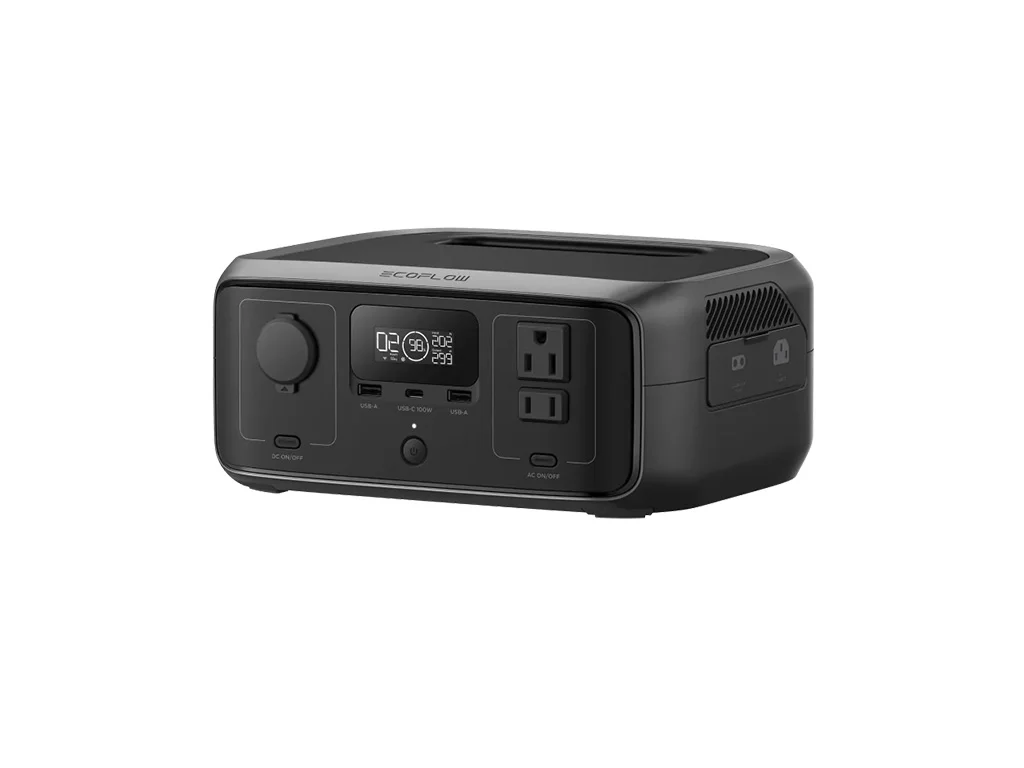
These two power stations have similar DC ports, including:
- Two USB-A ports
- One 100W USB-C port
- One ~120W car cigarette lighter outlet
The USB-C port on both the Bluetti EB3A and EcoFlow River 3 is powerful enough to charge many laptops and other medium-sized devices. The USB-A ports are great for charging other smaller devices.
The Bluetti EB3A has a wireless charging pad which the River 3 does not. This is one major advantage of the Bluetti. It also has two 5521 DC connections (barrel plugs). These can also be useful for things like CPAP machines or other devices that usually use an AC to DC adapter.

AC Outputs: Inverter and Outlets
As we turn to the AC capabilities, both of these include low-powered inverters. They’re enough for small devices, but can’t power a hairdryer, big entertainment system, or other devices that need a lot of energy. If you want to power larger devices, you should consider getting a bigger power station. We have a long list of 1000W power station options. Or you can go with ones that bring even more serious power, like the EcoFlow Delta 3 Plus or Bluetti AC180.
When it comes to the inverter rating between the EcoFlow River 3 and the Bluetti EB3A, Bluetti comes out ahead once again:
- Bluetti EB3A: 600W inverter with 1,200W surge rating
- EcoFlow River 3: 300W inverter with 600W surge and 600W X-Boost
This extra power from the EB3A can make a difference if you have a particular device that falls in the 300W to 600W range. Some blenders and other small kitchen appliances need around 400W.
Yet EcoFlow has found a loophole. It includes a special X-Boost technology which allows it to run at 600W for extended periods despite the 300W continuous rating. It does this by lowering the voltage, so it’s not suitable for every device. But for many with a basic electric motor, it does the trick.

UPS Function
These compact power stations are ideal for charging phones and running small devices. They’re also stepping up to replace uninterruptible power supply (UPS) devices. This UPS function allows you to constantly power a critical device like a computer or medical equipment by keeping the power station plugged into the wall outlet. When there’s a blackout or outage, the power station quickly switches to its internal battery power.
In this case, both options include a UPS function with <20ms transfer time.
For the Bluetti, the fan noise is a bit of a problem. You probably don’t want to hear a noisy fan kick on and off all day while you’re working on your computer. The EcoFlow River 3 resolved this issue with a fan noise of less than 30dB, barely a whisper. On top of that, continued use of the UPS is one area that appears to cause a higher failure rate of the Bluetti power station.
If you want to use this as a UPS to avoid data loss or damage, the EcoFlow River 3 is the better choice. However, it would be ideal to have a slightly faster switchover time of <10ms. The EcoFlow River 3 Plus (the larger cousin to the River 3) features this. The River 3 is the smaller new River model that gets a little less capability for its rock-bottom price.
Outlets and Inverter Verdict: Bluetti puts up a big fight with a wireless charging pad, extra DC ports, and a more powerful inverter. But the EcoFlow River 3 has special X-Boost technology, sufficient outputs, and a UPS function that is less noisy and more reliable.
| Product | EcoFlow RIVER 3 | BLUETTI EB3A |
|---|---|---|
| AC Output | 300W | 600W |
| AC Output Peak | 600W | 1,200W |
| AC X-Boost | 600W | – |
| 120V Outlets | 2 | 2x5A |
| UPS / EPS | 20ms | 20ms |
| USB-A Ports | 2x12W | 2x15W |
| USB-C Ports | 1x100W | 1x100W |
| DC 5521 (Barrel Plug) | – | 2x120W 10A |
| Cigarette Lighter | 1x126W | 1x120W |
| Wireless Charging Pad | – | 1x15W |
| Buy Now | Buy R3 | Buy EB3A |

How Long Will It Last? Battery Specs
The battery capacity determines how long the power station will run your devices. You also want to verify they feature a battery technology with longevity, safety, and density.
When looking at the EcoFlow River 3 vs. Bluetti EB3A comparison, they both have similar LiFePO4 batteries with about 250Wh. The LiFePO4 (LFP) is a great battery type with excellent longevity. These two are rated for at least 3,000 cycles with at least 80% battery capacity remaining. After about 8 years of charging and discharging daily, you can still get a very full charge out of them. LFP also has excellent safety and density.
The 250Wh capacity is enough for a lot of uses. For example, it can:
- Charge a 10Wh phone battery about 20 times
- Charge a 60Wh laptop about 3 times
- Power a 30W portable fridge for about 6 hours
- Run a 100W television or computer for about 2 hours
Reviews for many small power stations include frustration about the battery capacity. If you have overnight CPAP needs, these likely won’t cut it. Many CPAP devices run at about 40W. These will only last about 6 hours. By understanding what these can power, you can set your expectations accordingly.
You can use a simple formula to figure out how long the power station will last. You’ll need to know the running watts of the device(s) you want to power.
Take the battery capacity then divide by the running wattage of your devices. Subtract about 20% due to normal system inefficiencies (heat loss, wires/connectors, AC inverter use). Then you have a decent estimated hours of runtime. For example, a 20W light will last about 10 hours. 250Wh / 20W x 0.8 = 10 hours.
Battery Verdict: The difference in batteries between the EcoFlow River 3 and Bluetti EB3A is not significant. Both have industry-leading LiFePO4 battery types with about 250Wh, ideal for small devices and appliances only. Bluetti’s battery is a touch larger, but it’s not enough to make a noticeable difference in real-world use.

How Long to Recharge? Charging Speeds
No one wants to wait around forever for something to charge. For power stations, the charging speeds are not only determined by which source you use or how large your solar panels are, but also by the internal components of the power station.
What you want to find is a charging speed in watts that’s well balanced to the battery.
The EcoFlow River 3 and Bluetti EB3A both have excellent charging speeds, especially from a wall outlet. You can fully recharge either in just about an hour. EcoFlow’s is lightning-fast, but the EB3A speed is more than sufficient too.
For solar, the EB3A has the edge with a theoretical charging time of less than 2 hours. EcoFlow’s solar charging speed is closer to 3 hours.
Yet there’s a catch. Many people had difficulty getting close to the Bluetti EB3A’s full 200W charging speed from any DC input. If you look at the specs for these solar inputs, you can they’re more similar than not. The voltage and current (amps) are almost identical:
- Bluetti EB3A: 200W with 28V/8.5A maximum
- EcoFlow River 3: 110W with 30V/8A maximum
On top of that, the EcoFlow solar charging speed can still fully replenish the battery in one day of good sunlight and generate some excess. The 110W input is sufficient for this size battery. That’s the benefit of a small battery. If you need more solar power, then you should consider a larger power station too.
Charging Speed Verdict: Both power stations have fast charging rates suitable for the battery size. EcoFlow has a slight advantage for AC wall outlets (less than an hour). Bluetti has a theoretical advantage for solar charging, but the actual difference is minimal based on the underlying specs.
| Product | EcoFlow RIVER 3 | BLUETTI EB3A |
|---|---|---|
| AC Input | 320W | 268W |
| AC Recharge Hours (Est.) | 0.9h | 1.2h |
| Solar Input | 110W | 200W |
| Solar Recharge Hours (Est.) | 2.7h | 1.6h |
| Solar Input 1 Watts | 110W | 200W |
| Solar Input 1 Volts Min | 11V | 12V |
| Solar Input 1 Volts Max | 30V | 28V |
| Solar Input 1 Amps | 8A | 8.5A |

Weight and Dimensions
The size of some portable power stations have reached epic proportions, weighing over 100lbs (45kg). Of course, those are not the size of the compact power stations we’re looking at with this article.
Here, the EcoFlow River 3 has managed to pull off a miracle. It’s one of the smallest and best designed power stations we’ve ever seen, with a height of 4.4in (112mm).
We also are big fans of the integrated handle. And we’ll forgive you if you don’t see it right away. It’s hanging off the backside, out of the way. This avoids the problems with top-mounted rigid handles that make stacking or storing difficult. The Bluetti EB3A’s handle is on top but folds, so it’s still nice for being out of the way but there are concerns about the hinges breaking.
Size Verdict: Although the entire compact power station category has small sizes, the EcoFlow River 3 is next-level tiny. It has a great presence on your desk with ideal functionality, while still keeping the handle utility. Bluetti’s handle is a nice touch but more fragile.
| Product | EcoFlow RIVER 3 | BLUETTI EB3A |
|---|---|---|
| Weight (lbs) | 7.8lbs | 10.14lbs |
| Weight (kg) | 3.5kg | 4.6kg |
| Dimensions (in) | 10×8.3×4.4in | 10×7.1×7.2in |
| Dimensions (mm) | 254x211x112mm | 255x180x183mm |

Links to User Manuals
We have all of the important details for the EcoFlow River 3 and Bluetti EB3A in this article. But for any other questions, use these links to the official user manuals to find the answer:
| Product | EcoFlow RIVER 3 | BLUETTI EB3A |
|---|---|---|
| User Manual | User Manual | User Manual |

Final Verdict: Which Should You Choose?
There are a lot of great things about both of these power stations. They hit the target when it comes to small-scale energy needs and limited home backup use. Whether you want to charge your phone anywhere away from an outlet or keep a few devices running during a power outage, these will do the trick.
The Bluetti EB3A comes ahead with its wireless charging pad and bigger inverter. But reliability concerns and a larger physical size have us looking elsewhere. There are a lot of Bluetti products we will gladly recommend. This one might be worth passing over for greener pastures.
And that’s when we find the stunning EcoFlow River 3. It’s bringing in a new generation of power station style and function, with an impressive inverter that can handle double-duty action thanks to EcoFlow’s exclusive X-Boost technology. It’s smaller and sleeker, plus it has all the most important features and capabilities covered.
Final Verdict: Thanks to an ingenious design, superb capabilities, and hard-to-beat price, the EcoFlow River 3 is our choice over the Bluetti EB3A.
Get 5% off most EcoFlow orders with the discount code SOLARWAY5OFF. See our EcoFlow Sales, Deals, and Prices to make sure you save every penny possible.
|
|
EcoFlow RIVER 3 |
R3 on EcoFlow R3 on Amazon |
|
|
BLUETTI EB3A |
EB3A on Bluetti EB3A on Amazon |

Spec Comparison Charts
Power station comparison charts are a great way to see how capabilities, sizes, and features are different. This is one of our specialties and we work hard to give you these in-depth spec charts so you can see what meets your needs.
We’ll first stick to the River 3 vs EB3A charts. But don’t miss our favorite tool. You can pick any three power stations to compare from our most trusted brands down below.
EcoFlow River 3 vs. Bluetti EB3A
Here is the full spec comparison chart for the EcoFlow River 3 vs. Bluetti EB3A matchup:
| Product | EcoFlow RIVER 3 | BLUETTI EB3A |
|---|---|---|
| Battery | 245Wh | 269Wh |
| AC Output | 300W | 600W |
| AC Output Peak | 600W | 1,200W |
| AC X-Boost | 600W | – |
| AC Input | 320W | 268W |
| AC Recharge Hours (Est.) | 0.9h | 1.2h |
| Solar Input | 110W | 200W |
| Solar Recharge Hours (Est.) | 2.7h | 1.6h |
| Warranty | 2 years | 2 years |
| Weight (lbs) | 7.8lbs | 10.14lbs |
| Weight (kg) | 3.5kg | 4.6kg |
| Dimensions (in) | 10×8.3×4.4in | 10×7.1×7.2in |
| Dimensions (mm) | 254x211x112mm | 255x180x183mm |
| Solar Input 1 Watts | 110W | 200W |
| Solar Input 1 Volts Min | 11V | 12V |
| Solar Input 1 Volts Max | 30V | 28V |
| Solar Input 1 Amps | 8A | 8.5A |
| Battery Type | LiFePO4 / LFP | LiFePO4 / LFP |
| Battery Cycles | >3,000 | >3,000 |
| 120V Outlets | 2 | 2x5A |
| UPS / EPS | 20ms | 20ms |
| USB-A Ports | 2x12W | 2x15W |
| USB-C Ports | 1x100W | 1x100W |
| DC 5521 (Barrel Plug) | – | 2x120W 10A |
| Cigarette Lighter | 1x126W | 1x120W |
| Wireless Charging Pad | – | 1x15W |
| Connectivity | WiFi / Bluetooth | Bluetooth |
| User Manual | User Manual | User Manual |
| Buy Now | Buy R3 | Buy EB3A |
| Buy on Amazon | Buy on Amazon | EB3A on Amazon |

Compare to Any Power Station
This is our secret weapon. A tool that lets you compare these power stations and many more to get an immediate look at the differences.
Pick up to three power stations from the drop-down menus. Then select the group of specs you want to review (or choose “All Specs”). Once you click the button, a table will populate with your requested information.
Select Power Stations
Select up to three power stations to compare:
Get 5% off most EcoFlow orders with the discount code SOLARWAY5OFF.
|
|
EcoFlow RIVER 3 |
R3 on EcoFlow R3 on Amazon |
|
|
BLUETTI EB3A |
EB3A on Bluetti EB3A on Amazon |
Wrap Up
With so many excellent power stations on the market, making a purchase decision can be difficult. Make no mistake about it, you can trust the EcoFlow River 3 and Bluetti EB3A are two top options.
After going under our microscope, the EcoFlow River 3 is the top pick. It has the essential compact power station functions covered, plus it throw in a compact size you’ll have to see to believe. And it’s still packed with all the outputs and features you need, including <20 UPS backup speeds.
Want to see more power station comparisons? You can see full EcoFlow Comparison Charts or Bluetti Comparison Charts to see the full lineup from these brands. Or check out some of our other articles:


