
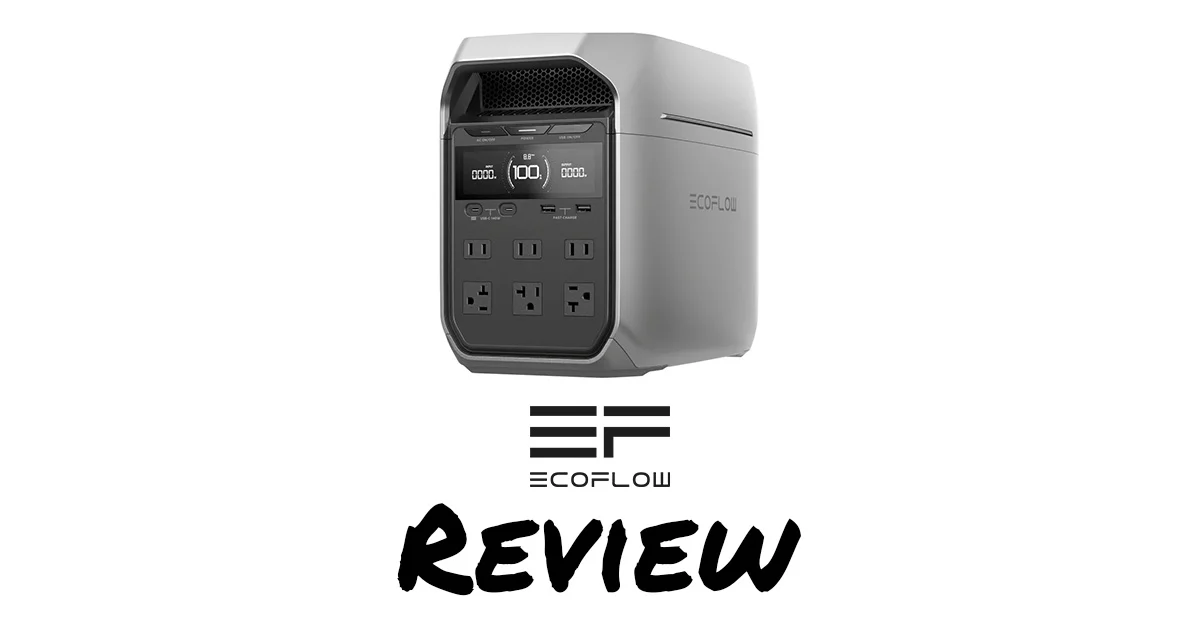
EcoFlow has yet again managed to push the definition of a portable power station forward. The EcoFlow DELTA 3 Plus brings more power to a smaller unit with tons of impressive features, including a 10ms UPS transfer time.
In this EcoFlow DELTA 3 Plus guide, we’ll review exactly what this power station can power and for how long. By taking a close look at its specs and details, this information can help you find out if this is the right device for your needs.
We carefully select the products and services we link to. If you buy through our links, we may earn a commission. There’s no extra cost to you and it helps us provide this information.
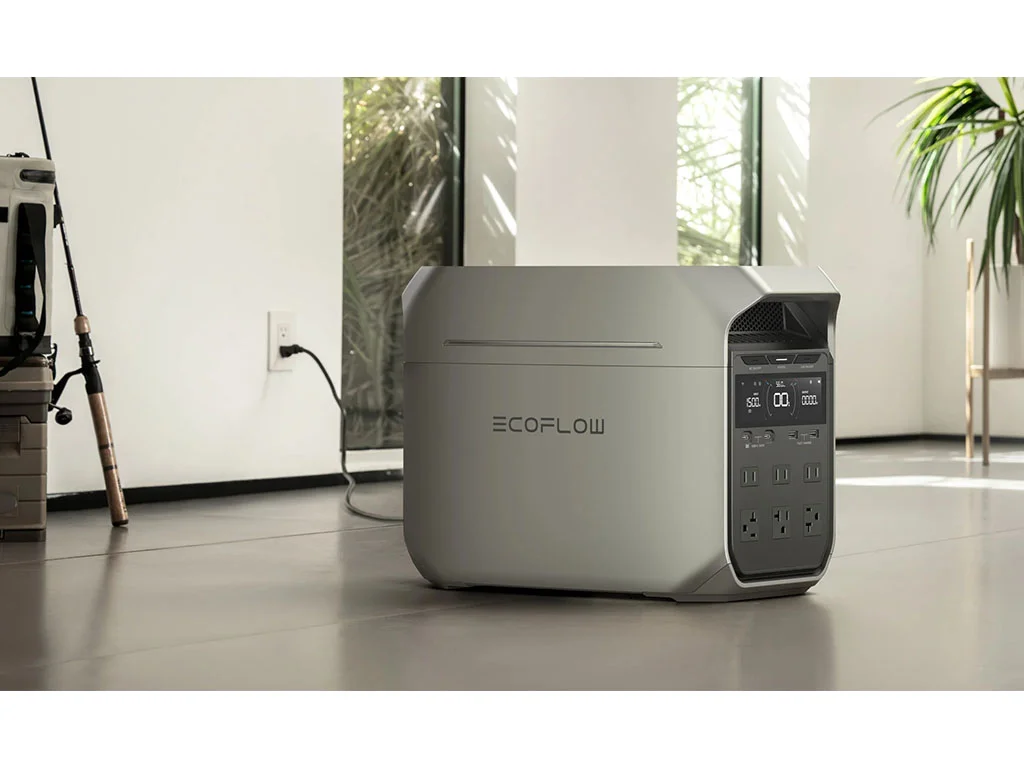
Quick Summary: EcoFlow DELTA 3 Plus
There are many things to love about the latest EcoFlow DELTA power station. What matters most is how it fits (or doesn’t fit) into your needs.
Main Highlights and Lowlights
This midrange power station from EcoFlow combines a powerful inverter with an expandable battery, while also including premium features typically only found on more expensive power stations.
Speaking of price, let’s start with that as the main highlight. Simply put, the DELTA 3 Plus price is an incredible deal. We have a huge bank of power station prices and specs. When we tried to find alternatives from other brands, the prices were consistently hundreds more. This power station is a great value.
Use our exclusive discount code SOLARWAY5OFF to get 5% off most EcoFlow products.
Besides the great price, the EcoFlow DELTA 3 Plus includes:
While we have zero reservations with this power station, there are a couple of points we can split hairs over:
A high-amp DC output isn’t found on any alternative in this segment, so that request is pushing it. Quite a few Bluetti power stations do offer wireless charging pads though.
Overall, the EcoFlow DELTA 3 Plus is an amazing power station. It hits a great price point backed by substantial power, yet somehow manages to squeeze it all on a light, compact unit.
|
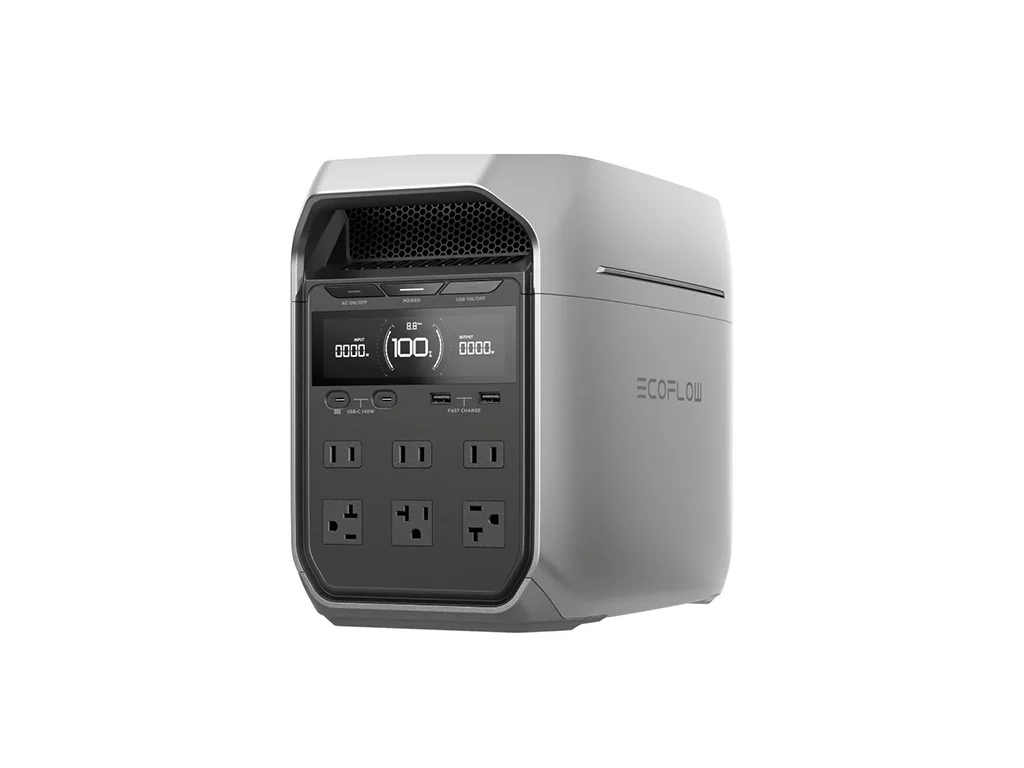
EcoFlow DELTA 3 Plus |
D3P on EcoFlow D3P on Amazon |

Comparison of DELTA Power Stations
This is not the most powerful EcoFlow power station. It is currently the smallest option out of the latest DELTA series, but still larger than any EcoFlow RIVER power station.
Here’s a quick comparison table of EcoFlow DELTA power stations (with the new RIVER 3 too):
| Product | Battery | Battery (System Max) | AC Output | Buy Now | Buy on Amazon |
|---|---|---|---|---|---|
| EcoFlow DELTA Pro Ultra | 6,000Wh | 90,000Wh | 7,200W | Buy DPU | EcoFlow DPU on Amazon |
| EcoFlow DELTA Pro 3 | 4,096Wh | 36,864Wh | 4,000W | Buy DP3 | Buy on Amazon |
| EcoFlow DELTA 3 Plus | 1,024Wh | 5,120Wh | 1,800W | Buy Now | Buy on Amazon |
| EcoFlow RIVER 3 | 245Wh | 245Wh | 300W | Buy R3 | Buy on Amazon |
If you want whole-home backup power, the DELTA Pro Ultra or DELTA Pro 3 will be better options. They have much more power and battery capacity.

Best Uses for EcoFlow DELTA 3 Plus
The DELTA 3 Plus is a lightweight compared to EcoFlow’s heavy-duty models, but it’s still an excellent midrange power station. As long as your expectations fit this model, it can be a perfect choice.
Here are the ways the EcoFlow DELTA 3 Plus is best to use:
- Home Backup: Short-term outages for critical devices and some appliances (fridge included)
- RV Power: A great way to instantly add up to 1kW of solar to any RV and power some devices/appliances
- Camping Trips: High powered camping unit ideal for powering fridge, lights, portable electronics for days
Just remember, for home backup and RV use, there is no high-amp output. You can use the 110V/120V outlets to run a lot of pretty hefty appliances, but it’s not a full house or large RV solution. For camping, it’s a lot of power that can be ideal if you have a portable fridge and other devices.
DELTA 3 Plus Specs
We’re going to go over many of the power station specs below, but here’s a quick overview of the most important EcoFlow DELTA 3 Plus specs:
| Product | EcoFlow DELTA 3 Plus |
|---|---|
| Battery | 1,024Wh |
| Battery (System Max) | 5,120Wh |
| AC Output | 1,800W |
| AC Input | 1,500W |
| AC Recharge Hours (Est.) | 0.8h |
| Solar Input | 1,000W |
| Solar Recharge Hours (Est.) | 1.2h |
| Warranty | 5 years |
| Weight (lbs) | 27.6lbs |
| Weight (kg) | 12.5kg |
| Battery Type | LiFePO4 / LFP |
| Battery Cycles | >4,000 |
| 120V Outlets | 6 |
| UPS / EPS | 10ms |
| USB-A Ports | 2x36W |
| USB-C Ports | 2x140W |

Understanding What This Power Station Can Do
Now it’s time for our favorite part of our power station guides. We’re here to go through the specs in detail, cutting through the big marketing claims to help you understand what the DELTA 3 Plus is capable of powering and for how long. You also might want to check out our article on How to Understand Power Station Specs.
Here are the things we’re going to cover:
- What sort of devices you can power
- How long the DELTA 3 Plus can run for
- How long it takes to recharge this power station
- Entire spec sheet and link to the user manual

What Can the DELTA 3 Plus Power?
There’s no point in getting a power station that can’t run the devices you want to use. There are a lot of aspects to consider, but the starting point should focus on the output potential. In other words, how much power can the power station provide at one moment?
The DELTA 3 Plus has:
- DC ports and power ratings: 7 outlets with up to 140W through USB-C ports
- AC outlets and inverter rating: 6 outlets with up to 1,800W total power
- <10ms UPS function
To get the most out of the battery, use the DC outputs such as the USB ports. The DELTA 3 Plus has four USB ports, including two 140W USB-C. For charging small devices or running basically anything that can use USB-C, including laptops, the DELTA 3 Plus has you covered. And it exceeds the DC output of rivals.

Some devices require AC power, the same as a standard US 110V/120V outlet. To change the DC power from the battery into AC for your devices, the power station uses the AC inverter.
The DELTA 3 Plus has 6 AC outlets and an inverter that can handle up to 1,800W, with a special X-Boost technology up to 3,600W. The most power that can go out through all 6 outlets at one time is 3,600W. But you are better off sticking to the 1,800W level for any sensitive device. This matches most power stations in this class.
Here’s a quick list of the power needs of certain devices which usually require AC power:
- ~200W: Televisions and desktop computers
- ~500W to 1,000W: Home refrigerators, powerful blenders, and coffee makers
- ~1,000W or more: Microwaves, induction cooktops, and electric kettles
You can power most of these devices off of an EcoFlow DELTA 3 Plus. When using a microwave or similar device around 1,500W, you want to turn off everything else. The DELTA 3 Plus will not power things like a 2,000W air conditioner or other heavy-duty appliances.
The <10ms UPS function is something usually not found on power stations. This allows you to use the DELTA 3 Plus to constantly power critical devices, like a computer or medical device, while also having the power station plugged into a wall outlet. If grid power fails, it will switch to battery power within 10ms. This is often fast enough to avoid computer shutdown. Other power stations in this class have 20ms UPS transfer time, which may result in a quick power loss.
Here is a full list of the specs that matter for trying to power things from the DELTA 3 Plus:
| Product | EcoFlow DELTA 3 Plus |
|---|---|
| AC Output | 1,800W |
| 120V Outlets | 6 |
| UPS / EPS | 10ms |
| USB-A Ports | 2x36W |
| USB-C Ports | 2x140W |
| DC 5521 (Barrel Plug) | 2x38W 3A |
| Cigarette Lighter | 1x126W |
| Buy Now | Buy D3P |
How Long Will the DELTA 3 Plus Run For?
The battery capacity determines how long the power station will run any particular set of devices. It’s also important to understand what type of battery is used because that’s basically how long the power station will last, based on the number of “cycles” it can be charged and discharged. Warranty length often relates to the battery type.
There’s a pretty simple calculation to use to see how long any power station will run any device: Watt-hours divided by the device wattage (less 20%) tells you the hours of runtime. (Wh / W * 0.8 = hours). 20% less accounts for the expected loss of the power inverter and other normal inefficiencies.
The DELTA 3 Plus has a 1,024Wh (1kWh) internal battery pack. This is a lot of power, capable of charging a 10Wh phone battery about 80 times.

If that’s not enough power, you can add on EcoFlow Extra Batteries to increase the capacity to 5kWh (equal to about 400 phone batteries). Having the ability to add an extra battery is something usually not found at this midrange level of power station, especially at this price.
This can serve as an excellent home backup for about 5-10 hours, covering a home fridge, some lights, a TV, plus a handful of small devices like phones, tablets, and a router. That all uses around 500W to 700W at a time. 5,000Wh battery divided by 500W (less 20%) is ~8 hours.
For camping trips, the DELTA 3 Plus is great, even without any extra batteries. You can run a 60W portable fridge and charge around 4-5 phones or tablets for about one day without any charging! Add on a Starlink Mini and a full laptop charge and you are still well over 12 overs of runtime. For more time, add solar panels or extra batteries.
This battery is a LiFePO4 cell technology, one of the best battery types for off-grid use. And it’s rated for a whopping 4,000 cycles while still keeping at least 80% of its charge. That’s more than 10 years of daily use without a noticeable decline in battery capacity. You can’t beat that.
Overall, the runtime for the EcoFlow DELTA 3 Plus is excellent based on the internal battery alone for limited home backup and pretty significant camping electronics. The ability to add on more extra batteries extends that amount of time in a way that sets the DELTA 3 Plus apart from the crowd.
| Product | EcoFlow DELTA 3 Plus |
|---|---|
| Battery | 1,024Wh |
| Battery (System Max) | 5,120Wh |
| Warranty | 5 years |
| Battery Type | LiFePO4 / LFP |
| Battery Cycles | >4,000 |

How Long to Recharge this Power Station?
The third thing to be aware of with any power station is how quickly you can recharge it. This isn’t just determined by how many solar panels you connect or how powerful the wall outlet is. The power station has charge controllers that use those power sources to recharge the battery, and they have specific speeds (in watts) that they can recharge at.
You cannot find better recharge rates on a power station that’s close to this one. The EcoFlow DELTA 3 Plus charging rates are lightning fast, for both AC wall outlets and from DC sources like solar and even car charging.
- AC charging: The AC rate basically uses all of the 15A available from any normal household power outlet. Can’t be beat.
- Solar input: More than any similar power station and enough to recharge in less than 1.5 hours.
- Car charging: Using the EcoFlow Alternator Charger, 800W rate is beyond anything else on the market.
What we like most about this power station as far as charging rates is the off-grid rates. Not only does this offer a powerful 1,000W of solar, but it does so through two ports with very high voltage limits (which you can’t exceed). This makes it easy to use almost any panel to meet that 1,000W.
On top of that, most power stations come with very wimpy car charging capabilities, usually around 120W which is the maximum 10A 12V from a car’s cigarette lighter port. You can use that to recharge the DELTA 3 Plus. Or if you want to recharge this power station from a car much faster, you can use the EcoFlow 800W Alternator Charger. This is more than 6 times faster than the usual car charging rates.
You will not be disappointed with the time it takes to recharge the EcoFlow DELTA 3 Plus.
| Product | EcoFlow DELTA 3 Plus |
|---|---|
| AC Input | 1,500W |
| AC Recharge Hours (Est.) | 0.8h |
| Solar Input | 1,000W |
| Solar Recharge Hours (Est.) | 1.2h |
| Solar Input 1 Watts | 500W |
| Solar Input 1 Volts Min | 11V |
| Solar Input 1 Volts Max | 60V |
| Solar Input 1 Amps | 15A |
| Solar Input 2 Watts | 500W |
| Solar Input 2 Volts Min | 11V |
| Solar Input 2 Volts Max | 60V |
| Solar Input 2 Amps | 15A |

|
|
EcoFlow DELTA 3 Plus |
D3P on EcoFlow D3P on Amazon |
Full Specs: EcoFlow DELTA 3 Plus
Here is the entire table of specifications for the DELTA 3 Plus, along with the link to the official EcoFlow User Manual if you have any other questions.
We also have a post with the full comparison charts for all EcoFlow power stations. Or you can see how EcoFlow specs compare to Bluetti specs.
| Product | EcoFlow DELTA 3 Plus |
|---|---|
| Battery | 1,024Wh |
| Battery (System Max) | 5,120Wh |
| AC Output | 1,800W |
| AC Output Peak | 3,600W |
| AC Input | 1,500W |
| AC Recharge Hours (Est.) | 0.8h |
| Solar Input | 1,000W |
| Solar Recharge Hours (Est.) | 1.2h |
| Warranty | 5 years |
| Weight (lbs) | 27.6lbs |
| Weight (kg) | 12.5kg |
| Dimensions (in) | 8.0×15.7×11.2in |
| Dimensions (mm) | 202x398x284mm |
| Solar Input 1 Watts | 500W |
| Solar Input 1 Volts Min | 11V |
| Solar Input 1 Volts Max | 60V |
| Solar Input 1 Amps | 15A |
| Solar Input 2 Watts | 500W |
| Solar Input 2 Volts Min | 11V |
| Solar Input 2 Volts Max | 60V |
| Solar Input 2 Amps | 15A |
| Battery Type | LiFePO4 / LFP |
| Battery Cycles | >4,000 |
| 120V Outlets | 6 |
| UPS / EPS | 10ms |
| USB-A Ports | 2x36W |
| USB-C Ports | 2x140W |
| DC 5521 (Barrel Plug) | 2x38W 3A |
| Cigarette Lighter | 1x126W |
| Connectivity | WiFi / Bluetooth |
| User Manual | User Manual |
| Buy Now | Buy D3P |
| Buy on Amazon | Buy on Amazon |

Use our exclusive discount code SOLARWAY5OFF to get an extra 5% off most EcoFlow products.
Wrap Up
During our power station research and comparisons, EcoFlow power stations tend to reach the top of the charts. And this latest iteration of the DELTA Series is yet another showing of why EcoFlow beats out the competition.
The EcoFlow DELTA 3 Plus bring modular expansion to a midrange power station packed with advanced features like super-fast charging and <10ms UPS transfer time. It has the inverter and outlets to run almost any device. plus it can serve well as an adventure device or an emergency home power supply.
Ready for more? Don’t forget to find out how many solar panels you need. Or if this power station is a bit above your needs, head over to our 1,000W Power Station List for more affordable ideas that you can depend on.


